On July 26, 1945, the heavy cruiser USS Indianapolis arrived at Tinian Island in the Pacific. She had just completed a high-speed run from San Francisco — 6,000 miles in ten days. In her hold was a lead-lined canister containing enriched uranium-235 and components for the atomic bomb Little Boy.
The crew didn’t know what they were carrying. Captain Charles B. McVay III had been told only that the cargo was to be delivered at all costs, and that if the ship went down, the canister was to be placed in its own life raft.
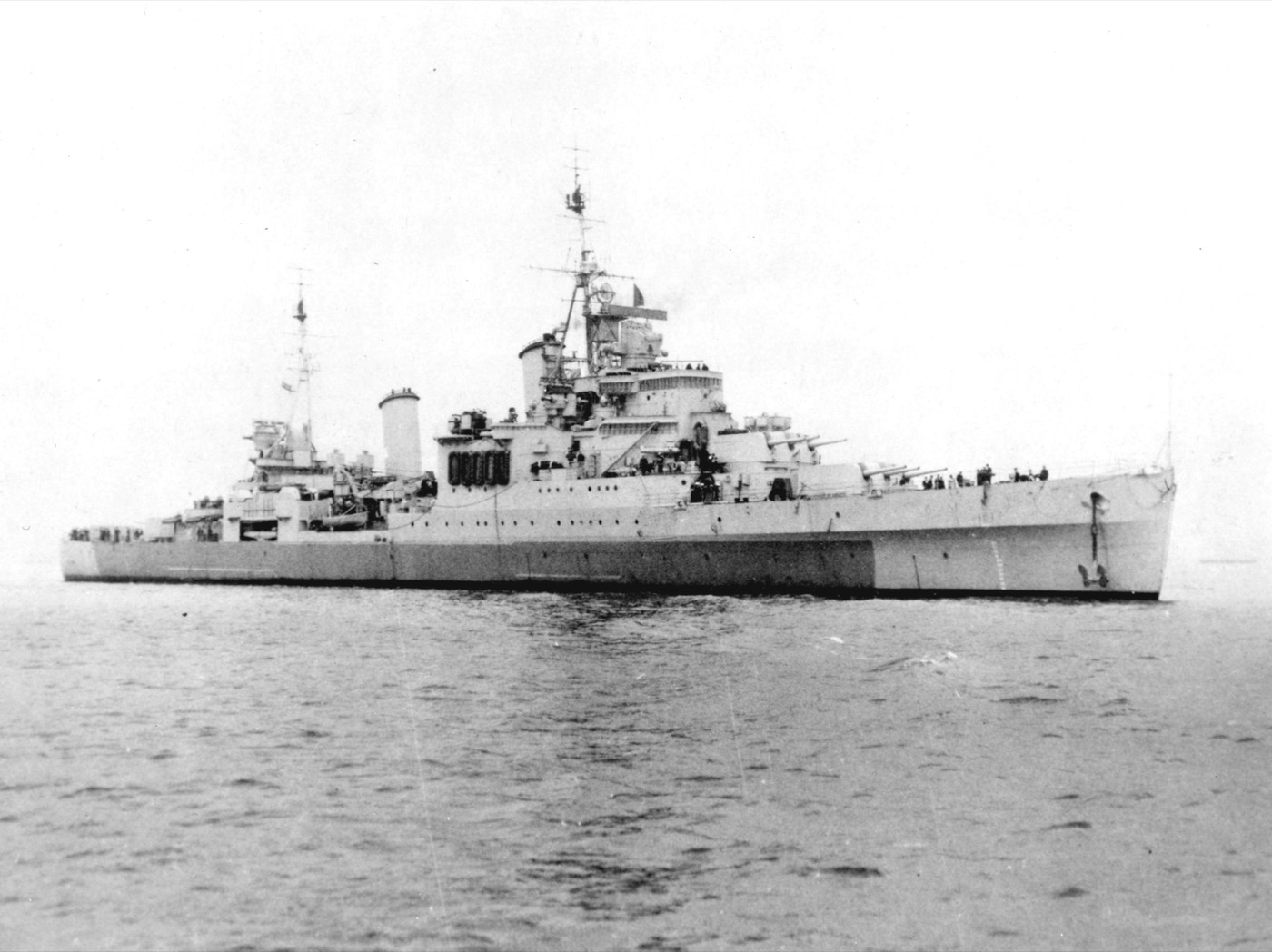
Indianapolis offloaded the uranium and left Tinian on July 28, bound for Leyte Gulf in the Philippines. She sailed without a destroyer escort. Her request for one had been denied. She was a Portland-class heavy cruiser, CA-35, 9,800 tons — considered capable of defending herself. Like the Cleveland-class cruisers flooding out of American shipyards that same year, she was built for a war that was almost over.
Two torpedoes, twelve minutes
Just after midnight on July 30, 1945, the Japanese submarine I-58 spotted Indianapolis. Commander Mochitsura Hashimoto ordered a spread of six Type 95 torpedoes. Two hit the cruiser on her starboard side.
The first torpedo struck near the bow and ignited a fuel tank. The second hit beneath the bridge, detonating the forward magazine. The explosions tore open the hull and knocked out all electrical power.
Indianapolis listed heavily to starboard and sank in approximately twelve minutes. Of a crew of roughly 1,196 men, an estimated 300 died in the sinking itself. About 900 went into the water.
No one came
Several distress signals were transmitted before the ship went down. Three separate Navy stations received SOS messages. None acted on them.
One station commander had left orders not to be disturbed. Another dismissed the signal as a Japanese trick. A third logged it and did nothing. The Navy’s port director at Leyte, where Indianapolis was expected, did not report her as overdue. A standing order at the time instructed port directors not to report the non-arrival of combatant ships.
For nearly four days, nobody in the United States Navy knew that a heavy cruiser and her crew were missing.
84 hours in the water
The men floated in the Philippine Sea in life jackets and small groups clinging to debris. They had almost no food, no fresh water, and very little in the way of life rafts. Temperatures dropped at night. The sun blistered exposed skin during the day.
The oceanic whitetip sharks arrived within hours. These are open-water predators that follow noise and movement. They circled the groups of survivors constantly. Attacks came most often at the edges of groups, picking off men who drifted away or thrashed in the water. Men who died of exposure, dehydration, or salt-water ingestion attracted more sharks.
Some survivors went mad from drinking seawater and hallucinated islands, fresh water, even ships. Groups fractured. Men swam away from the group toward nothing and did not come back.
On August 2, after roughly 84 hours in the water, a PV-1 Ventura patrol bomber piloted by Lieutenant Wilbur Gwinn spotted the survivors by accident. He had been flying a routine patrol and noticed an oil slick. He flew lower and saw men in the water.
Lieutenant R. Adrian Marks, piloting a PBY Catalina flying boat, landed in open ocean against standing orders to pick up survivors. He pulled 56 men from the water. The destroyer USS Cecil J. Doyle arrived that evening and began full rescue operations.
Of the roughly 900 men who entered the water, 316 survived.
The court-martial
The Navy convened a court-martial for Captain McVay in December 1945. He was charged with failing to zigzag and with hazarding his ship. It was the only time in the Second World War that a U.S. Navy captain was court-martialed for losing his ship to enemy action.
The prosecution’s own witness undermined the case. Commander Hashimoto, the man who had sunk Indianapolis, was brought from Japan to testify. He told the court that zigzagging would have made no difference. His torpedoes would have hit regardless.
McVay was convicted of failing to zigzag and acquitted of hazarding the vessel. The sentence was a loss of seniority, later remitted by the Secretary of the Navy. McVay was promoted to rear admiral upon retirement.
But the families of the dead never stopped blaming him. He received hate mail for decades — letters from parents and widows telling him he had killed their sons and husbands. Some arrived at Christmas.
On November 6, 1968, Captain McVay shot himself on his front porch. He was found holding a small toy sailor.
It took a twelve-year-old with a tape recorder to get the Navy to admit it was wrong.
A twelve-year-old and a resolution
In 1996, a twelve-year-old student in Pensacola, Florida, named Hunter Scott chose the USS Indianapolis for a school history project. He interviewed 150 survivors and compiled evidence that McVay had been made a scapegoat.
Scott’s research attracted the attention of Congress. Survivors who had stayed silent for fifty years began speaking publicly. They had always known the Navy’s failure to notice their absence was the real cause of the death toll.
On October 30, 2000, Congress passed a resolution exonerating Captain McVay. President Clinton signed it into law. The resolution stated that McVay’s record should reflect that he was exonerated for the loss of Indianapolis.
Hashimoto, still alive in Japan, had written a letter supporting McVay’s exoneration years earlier. The man who sank the ship said the captain should not have been blamed.
18,000 feet down
For seventy-two years, the wreck of Indianapolis sat undiscovered on the floor of the Philippine Sea. On August 19, 2017, a research team funded by Microsoft co-founder Paul Allen located the wreck using the research vessel R/V Petrel.
The ship rests at a depth of approximately 18,000 feet. The hull is largely intact. Her anchor is still in place. The Navy considers the site a war grave. Not every warship gets that dignity — some end up as floating casinos in foreign ports.
Indianapolis delivered the core of the weapon that ended the war in the Pacific. Four days later she was gone, and the Navy didn’t notice. The men who survived the sharks and the sea came home to watch their captain take the blame. It took a sixth-grader with a tape recorder to get the record corrected.
Frequently Asked Questions
Why was the USS Indianapolis not rescued for 4 days?
Three Navy stations received the ship’s SOS signals but none acted — one commander had left orders not to be disturbed, another dismissed it as a Japanese trick, and a third logged it and did nothing. A standing order told port directors not to report overdue combatant ships, so nobody at Leyte flagged Indianapolis as missing. The survivors were found by accident when a patrol bomber spotted an oil slick.
The full story: See the “No one came” section above for the complete breakdown of the Navy’s communication failures.
What happened to the captain of the USS Indianapolis?
Captain Charles B. McVay III was court-martialed for failing to zigzag — the only U.S. Navy captain court-martialed for losing a ship to enemy action in World War II. Even the Japanese submarine commander who sank Indianapolis testified that zigzagging would not have mattered. McVay received hate mail from victims’ families for decades and shot himself in 1968. Congress exonerated him in 2000.
The full story: See “The court-martial” and “A twelve-year-old and a resolution” sections above for the full account.
How many survivors were there from the USS Indianapolis?
Of the roughly 1,196 crew members aboard, about 300 died in the sinking itself and approximately 900 entered the water. After 84 hours exposed to dehydration, hypothermia, delirium, and constant shark attacks, 316 men were rescued. Oceanic whitetip sharks circled the groups continuously, picking off men who drifted away or thrashed at the edges.
The full story: See “84 hours in the water” above for the full account of the survivors’ ordeal.