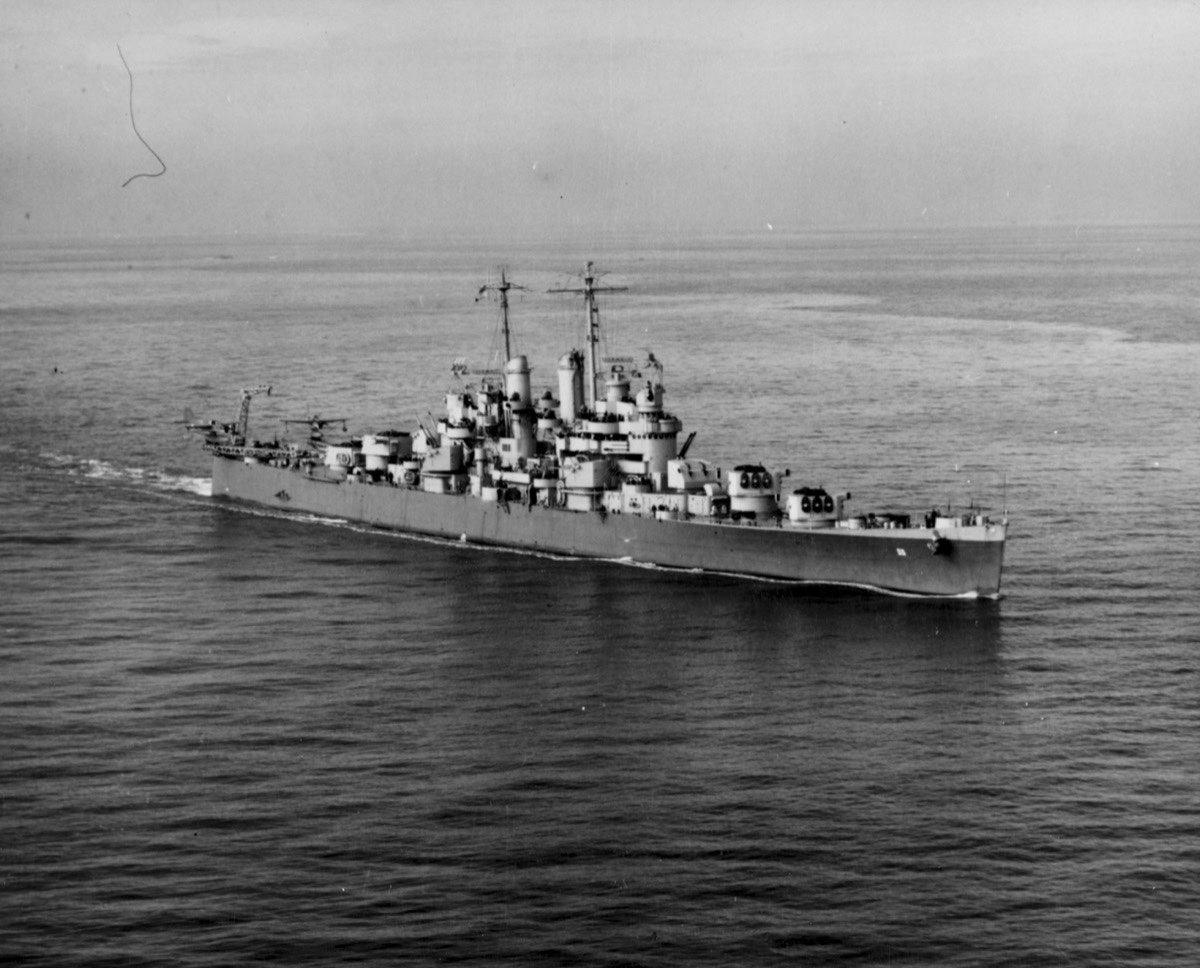
Twenty-seven Cleveland-class light cruisers were completed between 1942 and 1945. No cruiser class in any navy, in any era, has ever been larger. The US Navy ordered fifty-two hulls total.
They were good ships. Twelve 6-inch guns, twelve 5-inch guns, and, as the war went on, a growing forest of 40mm Bofors and 20mm Oerlikon antiaircraft guns bolted onto every available surface. Plus radar. Plus fire control directors. Plus ready-service ammunition lockers on the upper decks.
That was the problem. Every new piece of equipment went on top. The center of gravity kept climbing.
The Clevelands were designed at around 11,744 tons standard displacement. By 1944, the wartime additions had made them dangerously top-heavy. The Navy responded with a list of modifications that read like a weight-loss program:
Remove the aircraft catapults. Restrict topside ammunition stowage. Delete 20mm gun tubs. Rearrange fuel and water tanks lower in the hull. And add several hundred tons of solid ballast — concrete and lead — into the bottom of the ship.
It wasn’t enough to make anyone comfortable. The follow-on Fargo class was specifically redesigned with a flush deck and a single funnel just to cut topweight. Only two Fargos were completed before the war ended.
None of the 27 Clevelands were sunk in combat. That part of the record is clean — which is more than can be said for other American cruisers, like USS Indianapolis, which delivered the atomic bomb and then vanished. But the Clevelands served in nearly every major campaign from late 1942 onward.
At the Battle of Empress Augusta Bay on November 2, 1943, four Clevelands — Cleveland herself, Columbia, Montpelier, and Denver — under Rear Admiral Merrill defeated a Japanese force trying to intercept the Bougainville landings. It was a textbook night surface action.
USS Birmingham was alongside the light carrier Princeton on October 24, 1944, trying to help fight fires, when Princeton’s bomb magazine exploded. The blast killed 229 of Birmingham’s crew and wounded 420. It was one of the worst single-ship casualty events for any cruiser in the Pacific war, and Birmingham wasn’t even the ship that blew up.
But the most extraordinary chapter in the Cleveland story happened before most of them even touched water. In early 1942, the Navy desperately needed aircraft carriers. The Essex class was still years from completion. President Roosevelt pushed for a fast solution.
The Navy took nine Cleveland-class hulls already under construction and converted them into light aircraft carriers — the Independence class. Cruiser hulls became flight decks. They were narrow, cramped, and carried only about thirty aircraft. But they were fast — 31 knots on cruiser machinery — and they were ready.
USS Independence was commissioned in January 1943, less than a year after conversion began. Future President George H.W. Bush flew off USS San Jacinto, another converted Cleveland hull. USS Princeton — the only one lost — was sunk at Leyte Gulf.
Those nine carriers filled the gap until the Essex class arrived in numbers. Without them, the fast carrier task forces of 1943 wouldn’t have existed.
After the war, almost all 27 cruisers went into mothballs immediately. They were too new to scrap but too flawed to modernize — any new equipment would only make the stability problem worse. The irony is that US cruiser design had been wrestling with weight problems for years. USS Wichita earned the nickname “Pig Iron” partly because of how the Navy tried to solve the same issue with heavier construction. Six were eventually converted to guided-missile cruisers in the late 1950s.
Only one survives. USS Little Rock sits in Buffalo, New York, at the Buffalo and Erie County Naval & Military Park. She’s the last Cleveland-class ship you can walk through.
Sources
- Friedman, Norman. U.S. Cruisers: An Illustrated Design History. Naval Institute Press, 1984.
- Wikipedia: Cleveland-class cruiser
- Morison, Samuel Eliot. History of United States Naval Operations in World War II. Vol. 6 (Solomons) and Vol. 12 (Leyte Gulf). Little, Brown and Company, 1950-1962.
- NavSource Online: Light Cruiser Photo Archive
- Buffalo and Erie County Naval & Military Park: USS Little Rock