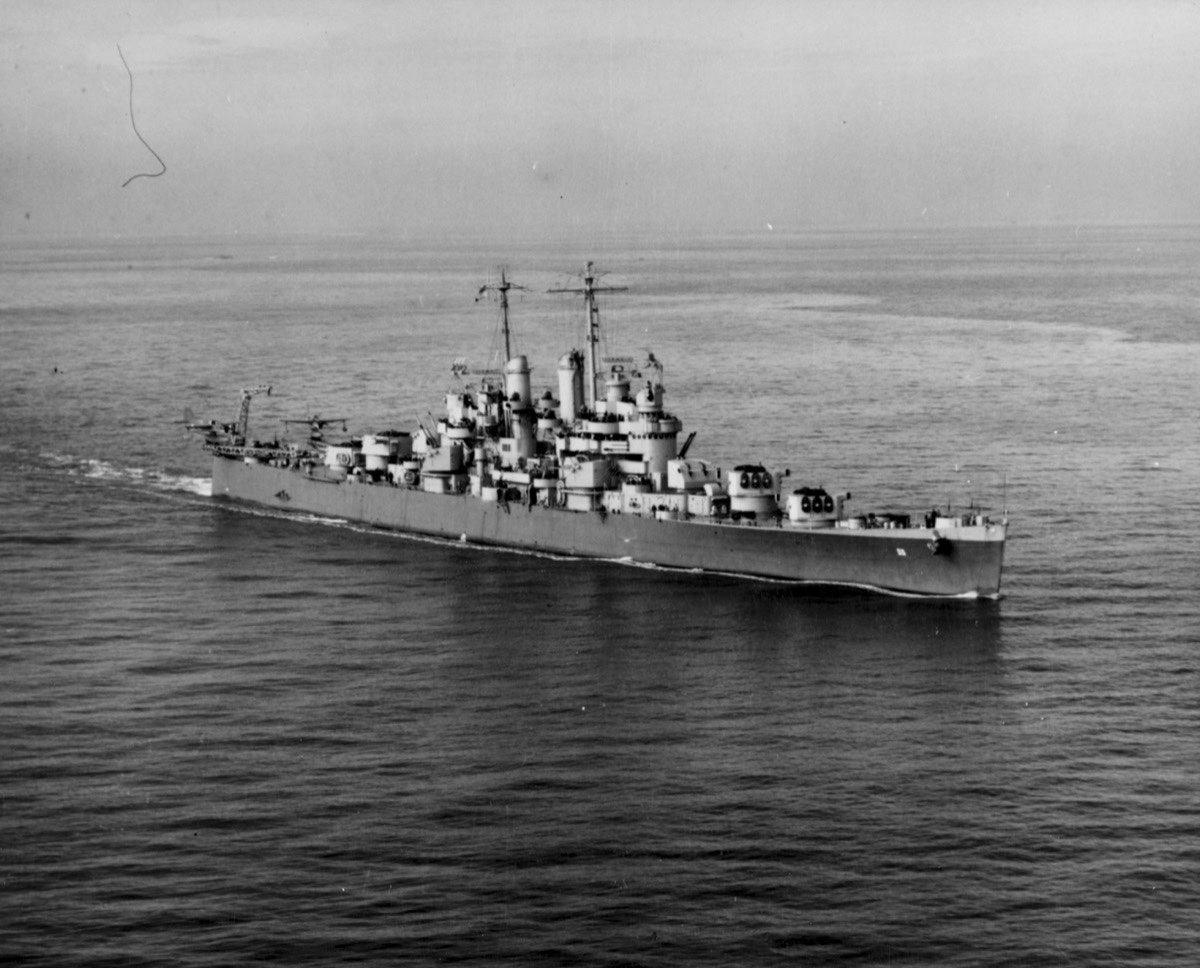
In 1935, the US Navy laid down a heavy cruiser at the Philadelphia Naval Shipyard. She would be the last American cruiser designed to meet the limits of the London Naval Treaty, which capped displacement at 10,000 tons.
They named her Wichita. She was a transitional design: New Orleans-class armament on a hull derived from the Brooklyn-class light cruisers, with more armor. The idea was straightforward: heavy cruiser guns, light cruiser hull, more armor.
The problem showed up when they installed all eight 5-inch guns. Wichita was top-heavy. Not a little. A lot.
The Navy’s solution was 200.4 long tons of pig iron, bolted to the bottom of the hull as ballast. Two hundred tons of dead weight, serving no purpose except to keep the ship from rolling over.
Only one Wichita was ever built. She was a prototype, and the Navy knew it. But her hull form, armor scheme, and general arrangement became the direct basis for the Baltimore class — fourteen heavy cruisers that fought through the rest of the war and into Korea. The Baltimores fixed Wichita’s stability problem by adding two feet of beam.
Wichita herself went to war carrying her pig iron.
She started in the Atlantic. Neutrality patrols, then Arctic convoy escort — the brutal Scapa Flow to Murmansk run. On November 8, 1942, she was part of the invasion of French North Africa at Casablanca. She dueled with the French battleship Jean Bart and coastal batteries at El Hank. A 194mm shell penetrated her deck and exploded below, injuring fourteen men.
In 1943, she transferred to the Pacific. At the Battle of Rennell Island on January 29, a Japanese torpedo hit her hull. It didn’t explode. She kept fighting.
At Leyte Gulf in October 1944, Wichita and three other cruisers ran down the crippled Japanese light carrier Chiyoda and destroyer Hatsuzuki. She fired 148 rounds of 8-inch armor-piercing ammunition at Chiyoda and 173 at Hatsuzuki. Both went down.
Off Okinawa on May 12, 1945, a friendly 5-inch round struck her port aircraft catapult. Shell fragments hit an antiaircraft director, killing one man and wounding eleven.
She earned 13 battle stars. Atlantic, Arctic, Mediterranean, Pacific. Two oceans, three years of combat, one torpedo that didn’t go off, and 200 tons of pig iron in her belly the entire time.
After the war, the Navy considered converting her into a guided-missile cruiser. They chose USS Boston and USS Canberra instead. Wichita was decommissioned on February 3, 1947, sat in mothballs for twelve years, and was sold for scrap on August 14, 1959.
No museum. No memorial. Just the fourteen Baltimore-class cruisers she made possible.
Sources
- Wikipedia: USS Wichita (CA-45)
- USS Wichita (CA-45) — Wikipedia
- Friedman, Norman. U.S. Cruisers: An Illustrated Design History. Naval Institute Press, 1984.
- Naval Encyclopedia: USS Wichita (1936)
- NavSource Online: USS Wichita CA-45