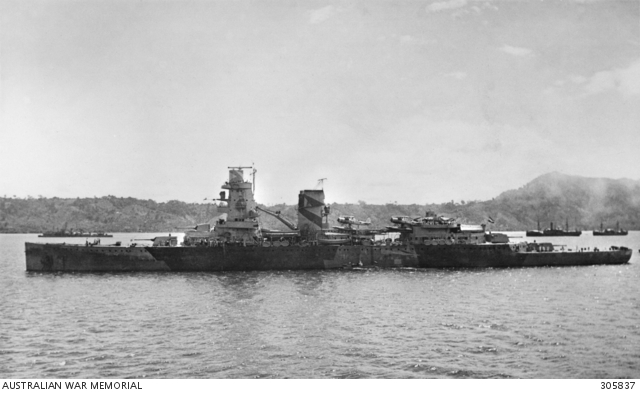
On the afternoon of February 27, 1942, Rear Admiral Karel Doorman led five cruisers and nine destroyers out of Surabaya to intercept a Japanese invasion fleet heading for Java. His ships represented four nations. His crews spoke four languages. They had no shared signal code, no common tactical doctrine, and no air cover.
He attacked anyway.
The fleet that wasn’t
The ABDA Combined Striking Force existed on paper for six weeks. ABDA stood for American-British-Dutch-Australian, a coalition assembled in January 1942 to stop Japan’s advance through Southeast Asia. It was a staff officer’s fantasy.
Doorman’s force included the Dutch light cruisers De Ruyter and Java, the British heavy cruiser HMS Exeter, the American heavy cruiser USS Houston, and the Australian light cruiser HMAS Perth. Houston’s aft turret had been knocked out by a bomb on February 4 and never repaired. She fought the entire battle with two-thirds of her main armament.
The destroyers were a mix of American, British, and Dutch ships. Some had never seen each other before that week. Communication between the Dutch flagship and the British and American destroyers relied on a single liaison officer on De Ruyter and a lot of hope.
There was supposed to be air reconnaissance. There wasn’t. Doorman sailed blind.
The aviator who went to sea
Karel Willem Frederik Marie Doorman was born in Utrecht on April 23, 1889, into a military family. He entered the Royal Netherlands Navy in 1906 as a midshipman. By 1915 he had a civilian pilot’s license. By 1916 a naval pilot’s license. He spent years building the Netherlands’ naval aviation arm and commanded the naval air base at Den Helder.
An arm injury ended his flying career. He went back to sea. By 1937 he was commanding cruisers in the Dutch East Indies. On May 16, 1940, six days after Germany invaded the Netherlands, he was promoted to rear admiral.
He raised his flag on HNLMS De Ruyter on June 13, 1940. He would fly it for twenty months.
Seven hours
At 16:00 on February 27, Doorman’s lookouts spotted the Japanese covering force: the heavy cruisers Nachi and Haguro under Rear Admiral Takeo Takagi, with two light cruisers and fourteen destroyers. The Japanese were escorting a convoy of forty-one transports carrying the troops that would take Java.
The Japanese opened fire at 16:16 at a range of roughly 28,000 yards. At 17:08, an 8-inch shell from Haguro hit HMS Exeter’s boiler room, cutting her speed from 26 knots to 5. The column behind Exeter swerved to avoid collision. Formation dissolved.
At roughly the same time, a Japanese torpedo hit the Dutch destroyer Kortenaer. She broke in half and sank in minutes. 59 of her 153 crew were pulled from the water later.
The British destroyers Electra charged the Japanese destroyer screen to cover Exeter’s withdrawal. She was hit repeatedly and sank. 54 of her 170 crew survived.
Doorman regrouped. He turned north, then west, then south, trying to find the Japanese transports. He had no reconnaissance aircraft. He had no radar. He was guessing.
At 21:25, the British destroyer Jupiter hit a Dutch mine and sank. 78 dead.
Doorman kept going.
The last signal
Sometime before midnight, with two cruisers and two destroyers already gone, Doorman signaled his remaining ships. The Dutch version is “Ik val aan, volgt mij.” The loose English translation entered history: “All ships follow me.”
Whether he used exactly those words is debated. The signal itself is not.
At 23:22, Doorman’s four remaining cruisers — De Ruyter, Java, Houston, and Perth — stumbled into Nachi and Haguro again in the dark. The Japanese launched Long Lance torpedoes. These were Type 93 oxygen-propelled torpedoes with a range of 40,000 meters and a 490-kilogram warhead. The Allies didn’t know they existed.
At 23:32, a Long Lance hit HNLMS Java. She exploded and sank fast. The crew never had a chance. 512 of her 528 men died.
At 23:36, a Long Lance hit HNLMS De Ruyter. The torpedo detonated her fuel tanks. Fire spread through the ship. She didn’t sink immediately. She burned.
Doorman’s last order, transmitted as De Ruyter flooded and burned, told Houston and Perth not to stop for survivors. Proceed to Tanjung Priok. Do not pick us up.
De Ruyter sank at approximately 02:30 on February 28. Rear Admiral Karel Doorman, 52 years old, and Captain Eugene Lacombla went down with her. 345 of the crew died with them. 111 survivors spent hours in the water before being rescued by a Japanese destroyer.
What followed
Houston and Perth escaped to Tanjung Priok. They sailed again the next night through the Sunda Strait, ran into another Japanese force, and were both sunk in the Battle of Sunda Strait on March 1. The combined death toll was over 1,000.
HMS Exeter, limping toward Ceylon for repairs, was caught on March 1 by Japanese cruisers. She was sunk along with the destroyers HMS Encounter and USS Pope.
Every major Allied warship that fought in the Battle of the Java Sea was at the bottom within 72 hours.
On March 8, the Dutch East Indies surrendered. Japan held the territory until 1945.
Total Allied dead from the Java Sea action and its immediate aftermath: approximately 2,300 sailors from four nations.
Four ships and a signal
Doorman was posthumously made a Knight Third Class in the Military Order of William on June 5, 1942, the Netherlands’ highest military decoration. Four ships of the Royal Netherlands Navy have been named Karel Doorman since his death: a light carrier, two frigates, and a joint support ship still in service today.
In 2002, divers located the wreck of De Ruyter on the floor of the Java Sea. In 2016, a survey found that large sections of the wreck had been illegally salvaged by scrap metal operations. Parts of the ship where 345 men died had been cut up and sold for steel.
The Dutch government filed a formal protest. The salvagers were never identified.
Sources
- Battle of the Java Sea - Wikipedia
- Karel Doorman - Wikipedia
- Karel Doorman - Britannica
- HNLMS De Ruyter (1935) - Wikipedia
- Battle of the Java Sea - Naval History and Heritage Command
Photo credit: HNLMS De Ruyter underway, circa 1936-1942 — Wikimedia Commons, File:HNLMS De Ruyter.jpg, Public Domain (Royal Netherlands Navy)