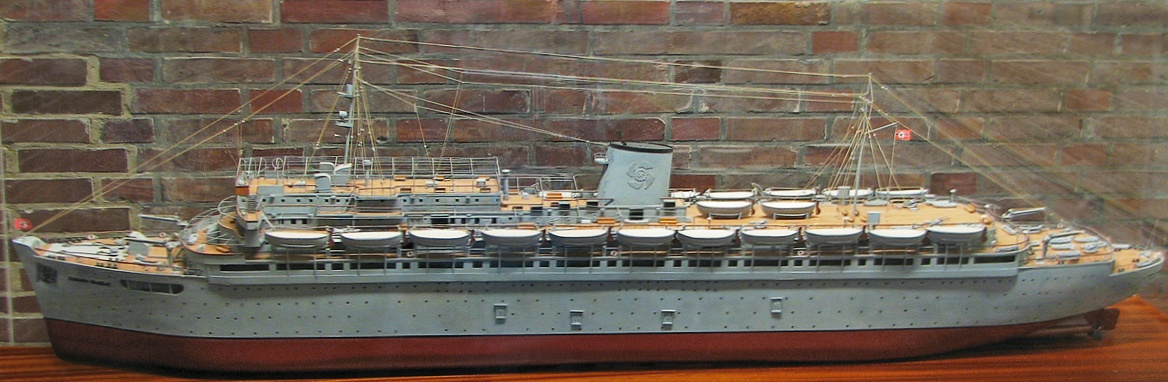
The deadliest ship sinking in history wasn’t the Titanic. It wasn’t even close. The Titanic killed 1,517 people. The ship at the top of this list killed six times that number, and most people have never heard of it.
Here are the worst naval disasters in history, ranked by the number of people who died.
1. MV Wilhelm Gustloff — ~9,343 dead (January 30, 1945)
The Wilhelm Gustloff was a German cruise liner turned military transport. On January 30, 1945, she left Gotenhafen (now Gdynia, Poland) packed with refugees fleeing the Red Army’s advance through East Prussia. The ship’s manifest listed 6,050 people. The actual number aboard was far higher — estimates range from 9,000 to 10,600. Thousands boarded without being recorded.
Soviet submarine S-13, commanded by Captain Alexander Marinesko, spotted the Gustloff that evening. Marinesko fired four torpedoes at around 9:00 p.m. Three hit the port side.
The ship sank in under 45 minutes. The water temperature in the Baltic was near freezing. German vessels rescued 1,252 survivors. An estimated 9,343 people died — roughly 5,000 of them children.
Nobody was court-martialed. Nobody was investigated. Germany was collapsing. The sinking barely made the news. Marinesko, who had been facing his own court-martial for alcoholism before the patrol, was denied the title Hero of the Soviet Union. The Soviet government decided he was “not suitable to be a hero.” He received the honor posthumously in 1990.
The Wilhelm Gustloff remains the deadliest maritime disaster in recorded history.
2. Junyo Maru — ~5,620 dead (September 18, 1944)
The Junyo Maru was a rusted Japanese cargo ship pressed into service as a transport. On September 18, 1944, she left Tanjung Priok, Java, carrying approximately 6,500 people: around 2,200 Allied prisoners of war and 4,300 Javanese forced laborers — romushas — being shipped to Sumatra to build a railway.
The British submarine HMS Tradewind, commanded by Lieutenant Commander Dorian Marsham Lynch, torpedoed the Junyo Maru in the Indian Ocean. The ship sank in under an hour.
Around 880 survivors were pulled from the water. Roughly 5,620 people died — 1,520 Allied POWs and over 4,100 romushas. The survivors were sent to Sumatra anyway and put to work on the Pekanbaru Death Railway. Many of them died there too.
HMS Tradewind’s crew had no way of knowing the ship carried prisoners and slaves. The Japanese used no markings and provided no notification.
3. HMT Lancastria — ~4,000 dead (June 17, 1940)
The RMS Lancastria, a converted Cunard liner, was anchored off Saint-Nazaire, France, loading British troops during the evacuation after Dunkirk — Operation Aerial. The ship’s official capacity was around 2,200. Captain Rudolph Sharp had been ordered to load as many men as possible without regard to capacity.
Estimates of the number aboard range from 6,000 to 9,000. Nobody counted.
At 3:48 p.m., a Luftwaffe Junkers Ju 88 dropped four bombs. At least two hit the ship. One went down the funnel. The Lancastria capsized and sank in under twenty minutes. Fuel oil spread across the water and caught fire. Men who survived the sinking burned to death in the oil.
Between 3,000 and 5,800 people died. The most commonly cited figure is around 4,000.
Winston Churchill suppressed the news. He placed a D-Notice on the sinking, telling aides: “The newspapers have got quite enough disaster for today at least.” Survivors were ordered not to speak about it. The story leaked out weeks later through American press. British government records on the Lancastria remain classified until 2040.
4. IJN Yamato — 3,055 dead (April 7, 1945)
Yamato was the largest battleship ever built. She displaced 72,800 tons fully loaded and carried nine 18.1-inch guns. On April 6, 1945, she left Tokuyama on a one-way mission to Okinawa — Operation Ten-Go. The plan was to beach herself on the shore and use her guns as a fixed battery until destroyed. She was given only enough fuel for a one-way trip.
American carrier aircraft found her the next morning. Between 12:37 p.m. and 2:23 p.m. on April 7, roughly 386 aircraft hit her with at least 11 torpedoes and 6 bombs. The forward magazines detonated. The explosion column rose four miles into the sky and was visible from the Japanese mainland.
Of 3,332 crew aboard, 3,055 died. That included Vice Admiral Seiichi Ito, who went down with the ship, and Captain Kosaku Aruga, who lashed himself to the helm. 276 men were rescued.
The biggest battleship in the world lasted less than two hours against carrier air power. She never fired her main guns at an enemy ship.
5. HMS Hood — 1,415 dead (May 24, 1941)
HMS Hood was the pride of the Royal Navy. At 48,360 tons, she was the largest warship in the world for twenty years. She was beautiful. She was also a battlecruiser — built for speed, not survivability — and her deck armor had never been upgraded to deal with plunging fire from modern guns.
On May 24, 1941, Hood and the new battleship HMS Prince of Wales engaged the German battleship Bismarck and heavy cruiser Prinz Eugen in the Denmark Strait. At approximately 6:01 a.m., a shell from Bismarck — probably a 15-inch round — penetrated Hood’s deck and reached the aft magazine.
The magazine exploded. Hood broke in two and sank in three minutes.
Of 1,418 crew aboard, three survived: Ordinary Signalman Ted Briggs, Able Seaman Robert Tilburn, and Midshipman William John Dundas. They were blown clear of the ship by an air blast from below and pulled from the water by the destroyer HMS Electra.
Three men out of 1,418. The rest went down with the ship in three minutes.
6. USS Indianapolis — 879 dead (July 30, 1945)
We’ve told this story in full. The short version: Indianapolis delivered the uranium core for the Hiroshima bomb to Tinian Island, was torpedoed four days later by the Japanese submarine I-58, and sank in twelve minutes. About 900 men went into the water.
The Navy didn’t notice she was missing. For four days.
Oceanic whitetip sharks circled the survivors for 84 hours. 316 men were pulled from the water. Captain Charles B. McVay III was court-martialed — the only U.S. captain in World War II convicted for losing his ship to enemy action. He shot himself in 1968. Congress exonerated him in 2000.
7. ARA General Belgrano — 323 dead (May 2, 1982)
The General Belgrano started life as USS Phoenix, a Brooklyn-class light cruiser that escaped Pearl Harbor without a scratch. She served the entire Pacific war, was sold to Argentina in 1951, and renamed.
On May 2, 1982, during the Falklands War, the British nuclear submarine HMS Conqueror hit the Belgrano with two Mark 8 torpedoes — a design from 1927, thirteen years older than the ship they struck. The Belgrano sank in under an hour. 323 Argentine sailors died. 770 survived.
The sinking was controversial. The Belgrano was outside the British exclusion zone and sailing away from the Falklands when the torpedoes hit. Captain Hector Bonzo survived and later said the British were justified. The ship was a warship in a war zone. He expected to be attacked.
The Belgrano was the second ship ever sunk by a nuclear-powered submarine. She was also a ship that had survived one war only to be killed in another by weapons older than herself.
8. HMHS Britannic — 30 dead (November 21, 1916)
The Britannic was the Titanic’s younger sister — the third Olympic-class liner, built by Harland and Wolff in Belfast. She never carried a paying passenger. The Admiralty requisitioned her in 1915 as a hospital ship.
On November 21, 1916, the Britannic struck a mine in the Kea Channel in the Aegean Sea. She sank in 55 minutes — faster than the Titanic, which took two hours and forty minutes.
But only 30 of the 1,066 people aboard died. The water was warm. Land was close. Ships were nearby. And the crew had learned from the Titanic. They evacuated fast and they evacuated well.
The Britannic is on this list not for her death toll but for the contrast. Same shipyard. Same design lineage. Same builder. The Titanic killed 1,517 people. The Britannic killed 30. The difference was proximity to shore, water temperature, and a crew that didn’t waste time pretending the ship wasn’t sinking.
The Titanic is the most famous shipwreck in history. But by the numbers, she doesn’t make the top five. The deadliest sinkings happened in wartime, to ships packed far beyond capacity, in waters where rescue was slow or nonexistent. The Wilhelm Gustloff alone killed more people than the Titanic, Lusitania, and Indianapolis combined.
Most of these ships have no museum. No James Cameron film. No exhibit in a Las Vegas hotel. The people who died on the Gustloff and the Junyo Maru and the Lancastria are mostly footnotes, if they appear in the history books at all.
Sources
- Wikipedia: MV Wilhelm Gustloff
- National WWII Museum: The Sinking of the Wilhelm Gustloff
- Wikipedia: Jun’yo Maru
- Wikipedia: HMT Lancastria
- Naval Historical Foundation: The Lancastria Tragedy
- Wikipedia: Japanese battleship Yamato
- Wikipedia: HMS Hood
- Wikipedia: Sinking of ARA General Belgrano
- Wikipedia: HMHS Britannic
- Britannica: Britannic
- Smithsonian: The Deadliest Disaster at Sea