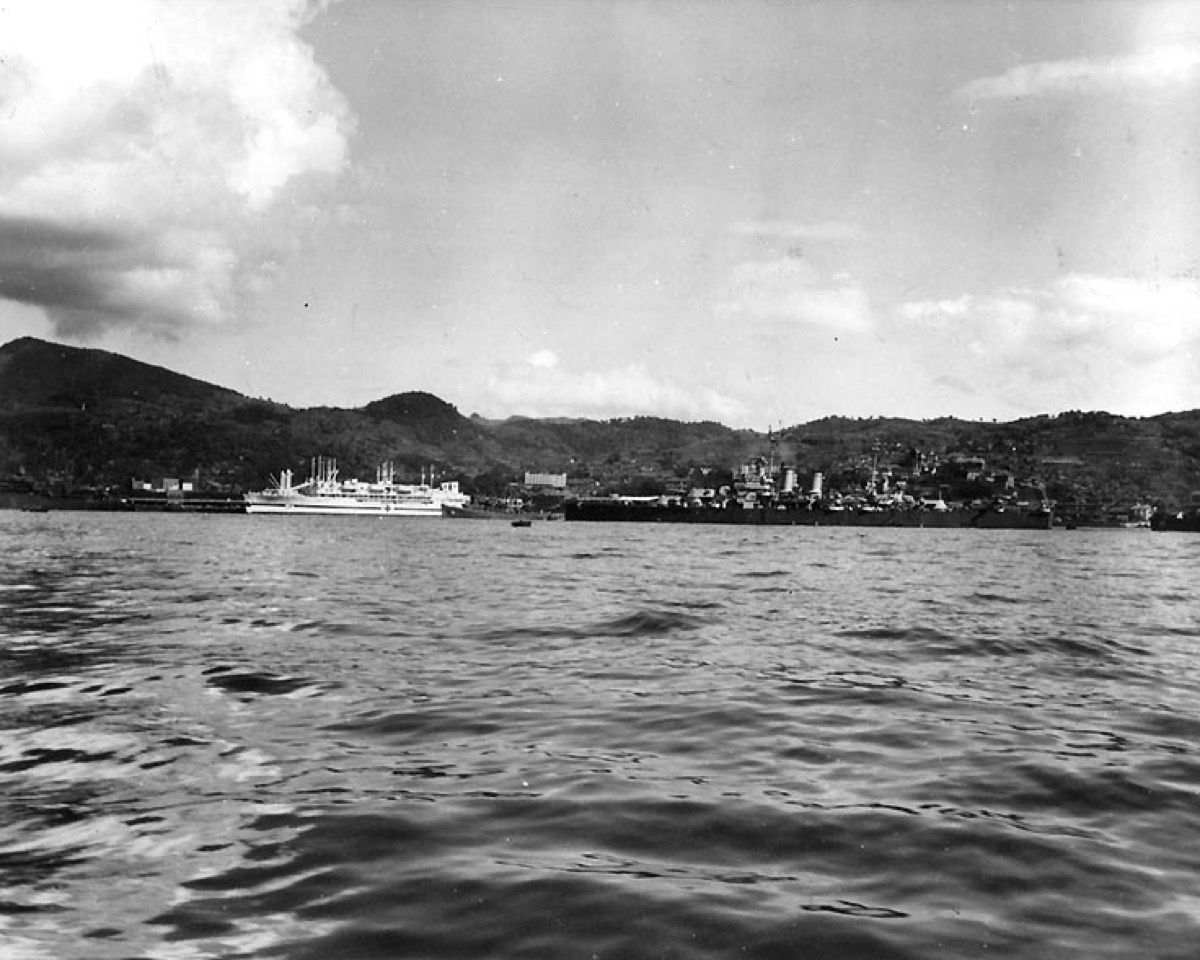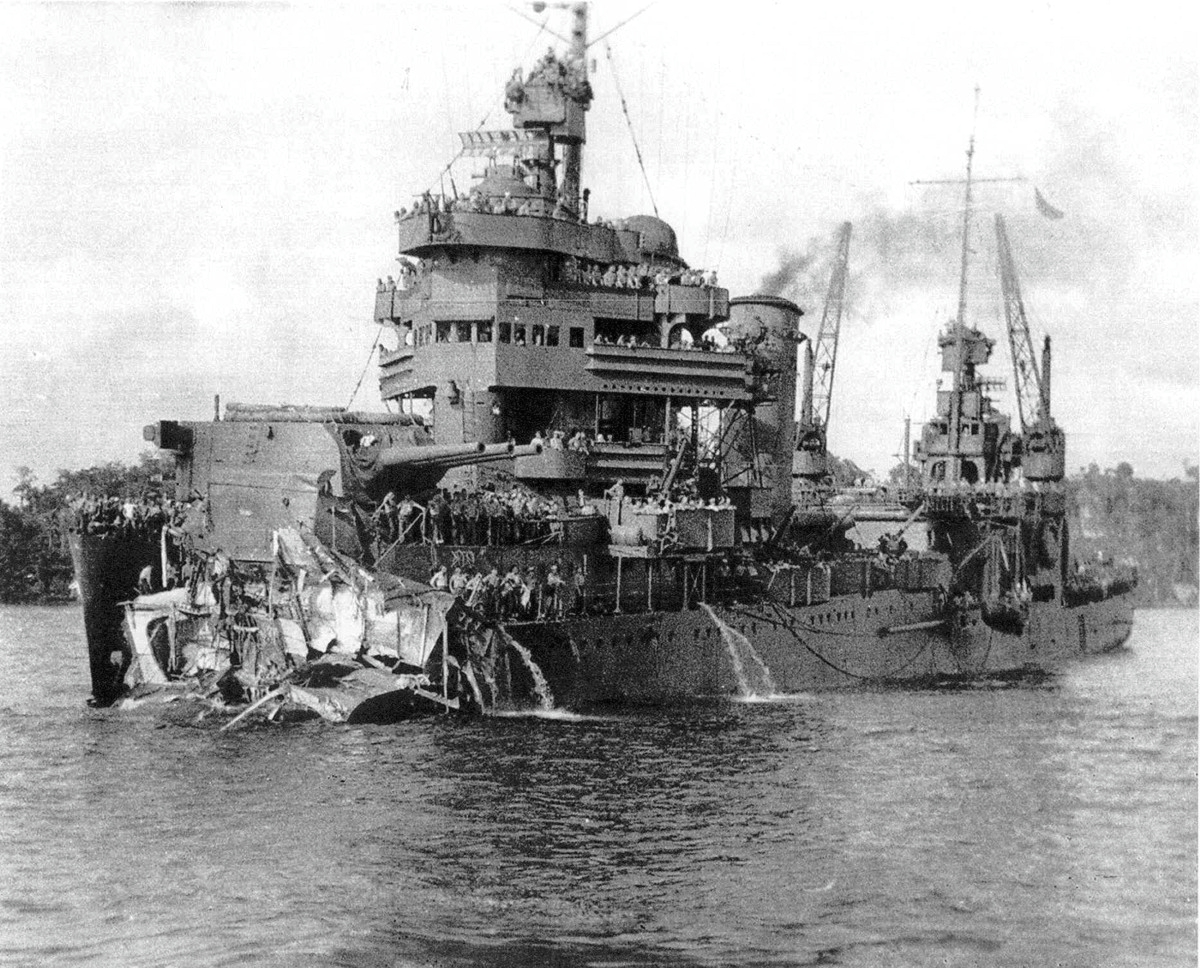
On the morning of December 7, 1941, USS Phoenix was moored northeast of Ford Island at Pearl Harbor. Battleship Row was burning. Arizona was gone. Oklahoma had capsized. West Virginia was sinking.
Phoenix got underway.
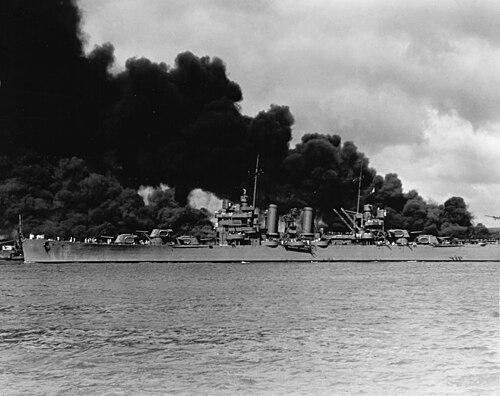
She cleared the harbor while bombs were still falling, joined cruisers St. Louis and Detroit outside the channel, and spent the next four years fighting across the Pacific. Corregidor. Hollandia. Leyte Gulf. Lingayen. Mindoro. Borneo. Nine battle stars.
At the Battle of Surigao Strait on October 25, 1944, she fired on the Japanese battleship Yamashiro during the last battleship action in history. Phoenix opened with spotting salvoes and then cut loose with all fifteen of her 6-inch guns.
She came through the entire war without serious damage.
Renamed twice
The Navy decommissioned Phoenix in 1946 and parked her at the Philadelphia Naval Shipyard. In 1951, Argentina bought her.
They named her ARA Diecisiete de Octubre, “17th of October,” after the day Juan Peron’s supporters marched on Buenos Aires and secured his political power. Four years later, the Argentine military overthrew Peron. The ship needed a new name. She became ARA General Belgrano, after Manuel Belgrano, an independence-era general with no connection to Peron.
Belgrano served the Argentine Navy for another 27 years. By 1982, she was 44 years old. The oldest cruiser in any navy. She’d been fitted with new radar and fire control, but the hull was the same one launched in Camden, New Jersey in 1938.
Two torpedoes
On April 2, 1982, Argentina invaded the Falkland Islands. Britain sent a naval task force 8,000 miles south to take them back.
On May 2, the nuclear submarine HMS Conqueror found Belgrano southwest of the Falklands, outside the 200-nautical-mile Total Exclusion Zone. The cruiser was sailing with two destroyers, ARA Piedra Buena and ARA Hipolito Bouchard.
Commander Chris Wreford-Brown had a choice of torpedoes. Conqueror carried Mark 24 Tigerfish, modern wire-guided weapons designed in the 1970s. She also carried Mark 8 torpedoes. The Mark 8 was designed in 1925. It ran in a straight line. No guidance, no wire. A 365-kilogram warhead aimed at where the target was going to be.
Wreford-Brown chose the Mark 8. The Tigerfish had a reputation for unreliable detonators. The Mark 8 had been killing ships for sixty years and had never had that problem.
At 4:01 PM local time, Conqueror fired three torpedoes. Two hit.
The first struck forward of the armor belt. The second hit the stern near the machine rooms. The ship lost power immediately. No pumps, no firefighting. Water flooded through both holes.
Captain Hector Bonzo ordered abandon ship twenty minutes after the first impact. Belgrano rolled to port and sank.
Three hundred and twenty-three men died. Seven hundred and seventy survived, many of them in life rafts in the South Atlantic. Water temperature was around 4 degrees Celsius. Some were not picked up for over 30 hours.
It was the first time a nuclear-powered submarine had sunk a surface ship in combat.
The Argentine Navy went home
After Belgrano sank, the Argentine surface fleet returned to port and stayed there for the rest of the war. The aircraft carrier ARA Veinticinco de Mayo, which had been preparing an air strike against the British task force, was recalled. From May 2 onward, the naval war was fought almost entirely by Argentine aircraft flying from the mainland.
”GOTCHA”
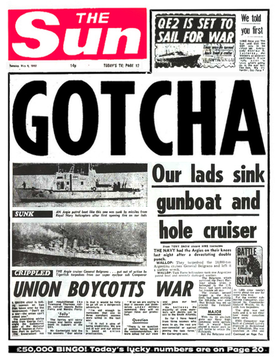
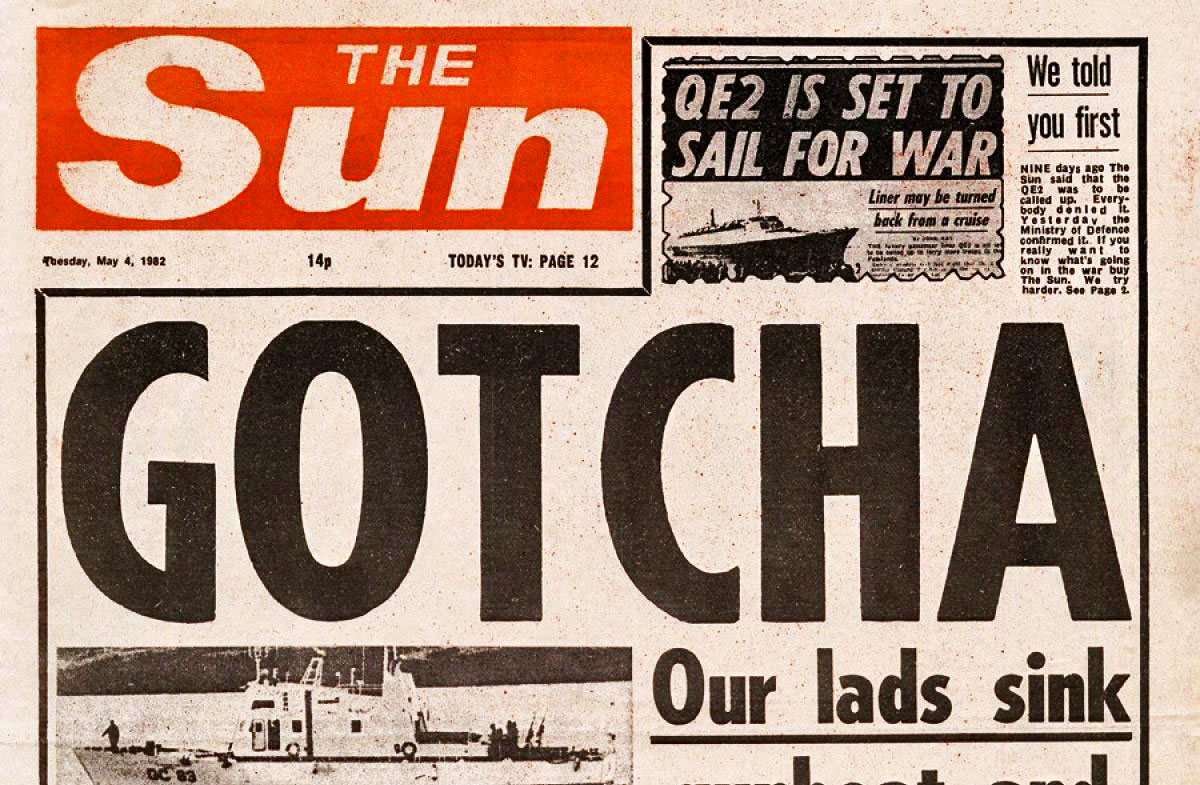
On May 4, The Sun ran a front-page headline: “GOTCHA.” The subheadline read “Our lads sink gunboat and hole cruiser.” Editor Kelvin MacKenzie pulled it after the first edition when casualty numbers came in.
The sinking was controversial for years. Belgrano had been outside the exclusion zone. She had been heading west, away from the Falklands, when the torpedoes hit. Critics accused Margaret Thatcher of ordering the attack to sabotage peace negotiations that were making progress.
The controversy lasted longer than the war.
”Lamentably legal”
Captain Bonzo survived. In 2003, twenty-one years after the sinking, he gave an interview. He said he’d been given orders to attack any British ship he could find. The Belgrano was not running away. She was maneuvering. The exclusion zone was a diplomatic line, not a legal shield.
“It was absolutely not a war crime,” Bonzo said. “It was an act of war, lamentably legal.”
The man who lost his ship and 323 of his crew said the British were right to fire.
Bonzo died in 2009.
Still missing
In 2003, the National Geographic Society sent an expedition to find the wreck. Explorer Curt Newport searched 800 square kilometers of seabed east of Tierra del Fuego. Waves reached 9 meters. Winds hit 110 km/h. The team quit after two weeks without finding the ship.
Belgrano is still down there, somewhere around 4,200 meters deep.
There’s a monument in Centenario Park, Buenos Aires, erected in 1991. It lists 323 names. The ship that escaped Pearl Harbor, crossed the Pacific, survived two changes of government, and fought in two hemispheres is on the bottom of a different ocean, sunk by a torpedo that was designed thirteen years before she was launched.
Sources