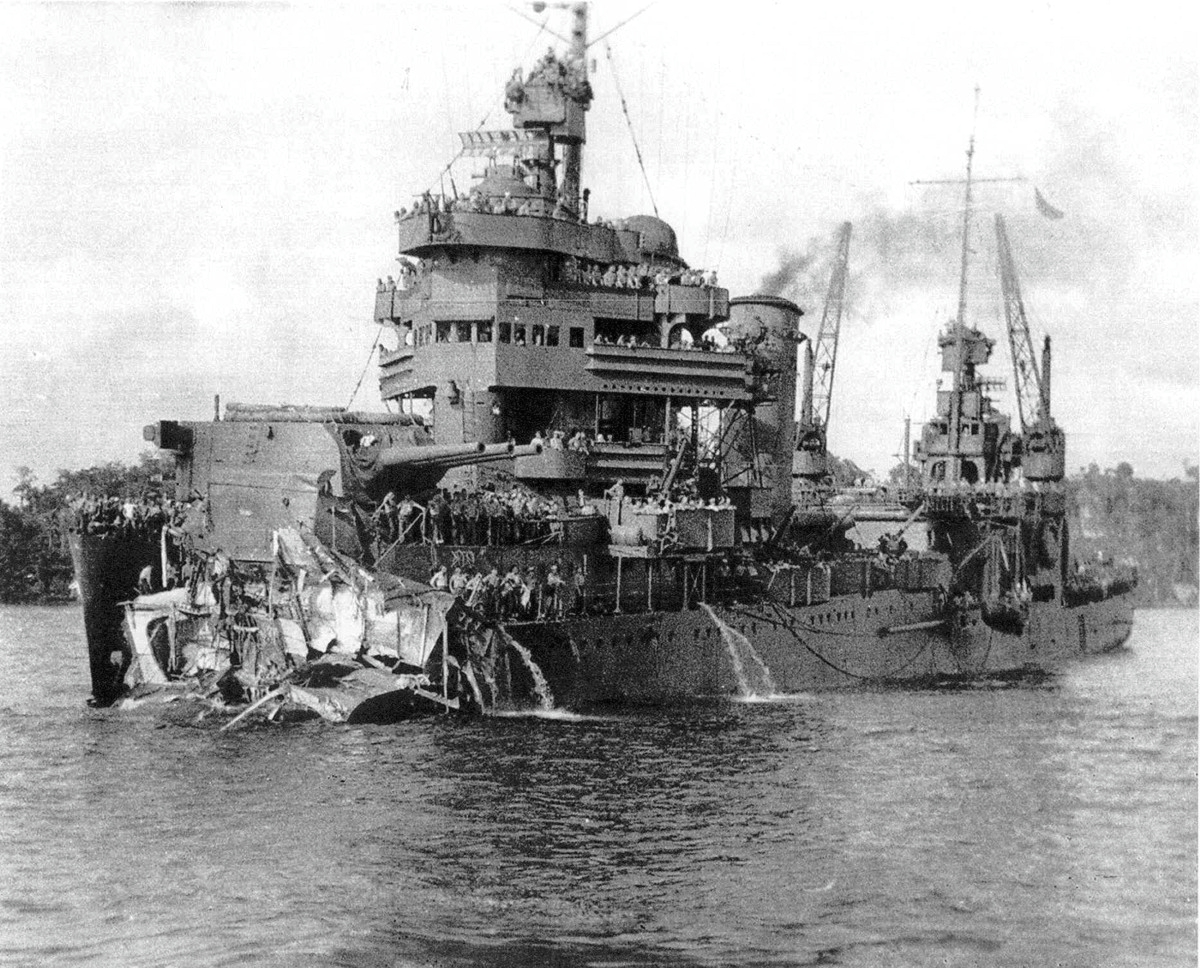
At 23:27 on November 30, 1942, a Japanese Type 93 torpedo hit USS New Orleans forward of turret No. 2.
The torpedo detonated the forward magazines. The explosion ripped off 150 feet of hull. That’s roughly a third of the ship. Turret No. 1, the forward fire room, crew quarters, storage compartments, the chain locker — gone. One hundred and eighty-two men died in the blast.
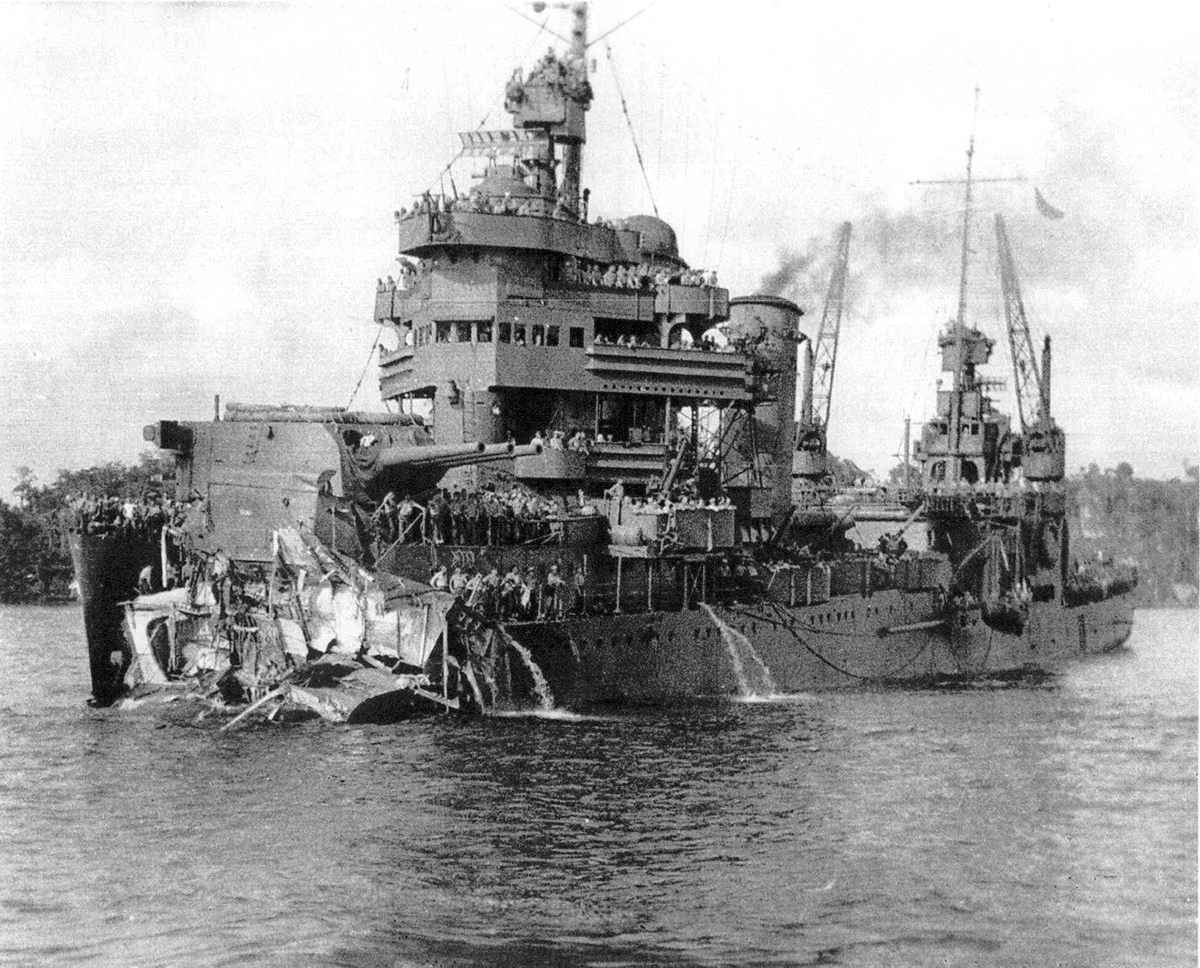
The severed bow didn’t sink immediately. It swung alongside the ship, punching holes in the port side as the New Orleans kept moving. The crew had to back engines to separate from their own wreckage. The bow scraped down the hull and disappeared into Iron Bottom Sound.
The ship that remained was open to the sea. Seawater flooded compartments. The forward bulkhead was the only thing keeping the Pacific Ocean out of the rest of the hull. If it failed, the ship would go down with it.
It held.
Tulagi
New Orleans limped across the sound to Tulagi harbor, arriving on December 1. She was drawing 36 feet forward — 10 feet deeper than normal — and listing to port. The crew anchored her in a concealed cove to hide from Japanese aircraft.
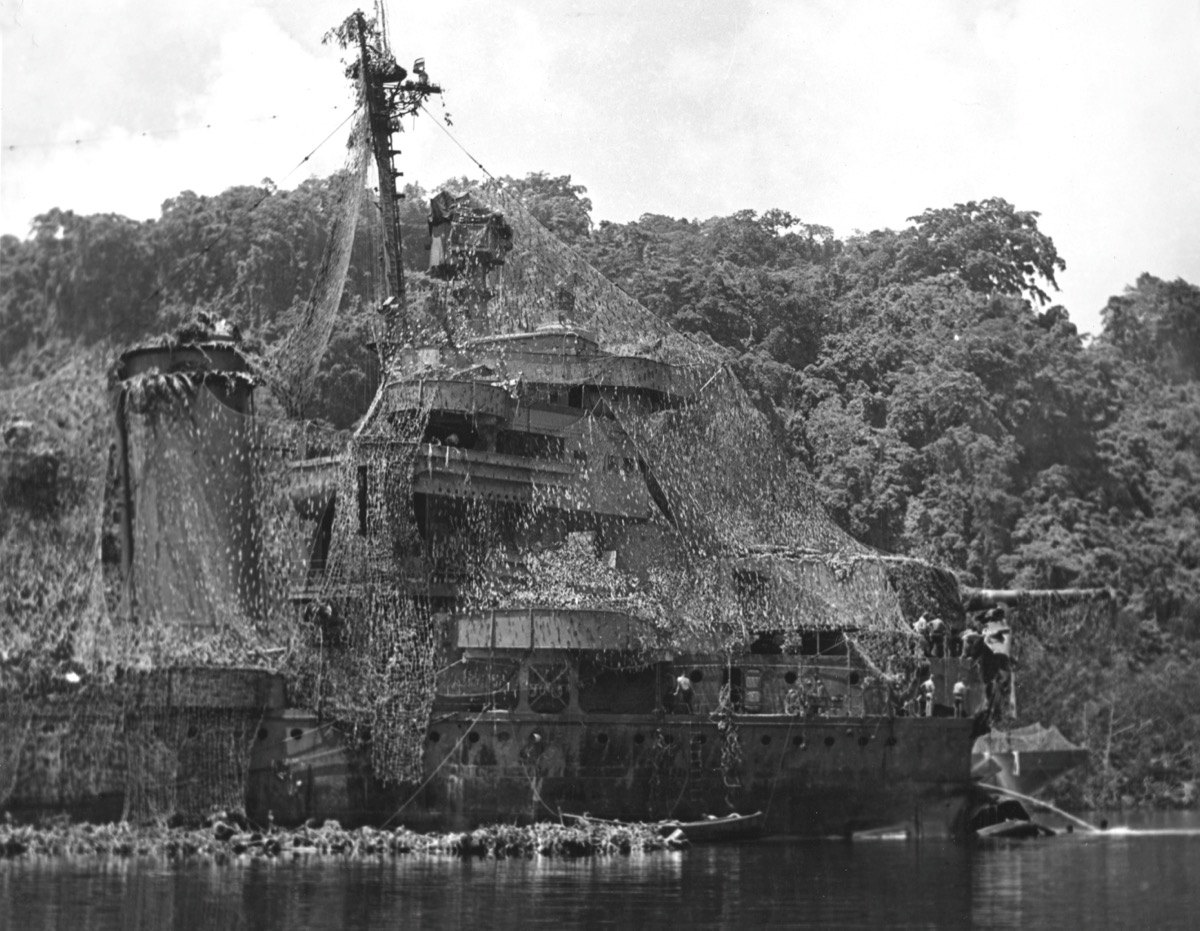
For 11 days, the crew worked to make the ship seaworthy. They had no drydock. No shipyard. No steel. What they had were coconut trees.
Sailors went ashore with axes and followed locals into the jungle. They felled coconut palms and dragged the logs back to the ship. They used the logs to build a temporary bulkhead across the open bow — a flat wall of coconut timber braced against the steel hull frame. It wasn’t a bow. It was a plug.
They welded steel plates where they could, shored up the bulkhead with timbers, and sealed everything they could reach. It was ugly. It needed to hold for 1,800 miles.
A 9,950-ton heavy cruiser, 588 feet long, designed to make 32 knots, crawling backwards across the Coral Sea at 5 knots. The helmsman steering by looking over his shoulder. For weeks.
Backwards to Sydney
On December 12, New Orleans left Tulagi, stern first.
She couldn’t sail bow-forward. The coconut log bulkhead would take the full force of the Pacific at the front of a moving ship. Water pressure at cruising speed would have torn it apart. So the crew drove the ship in reverse.
Think about that. A 9,950-ton heavy cruiser, 588 feet long, designed to make 32 knots, crawling backwards across the Coral Sea at 5 knots. The helmsman steering by looking over his shoulder. For weeks.
She arrived in Sydney on December 24. Christmas Eve. The Australians in the harbor stared at the ship that was sailing the wrong way with a flat wooden wall where her bow should have been.
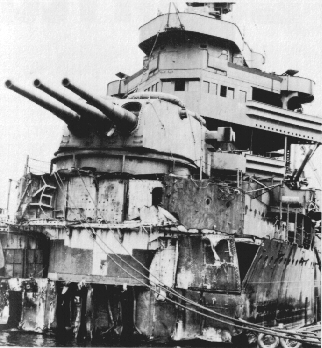
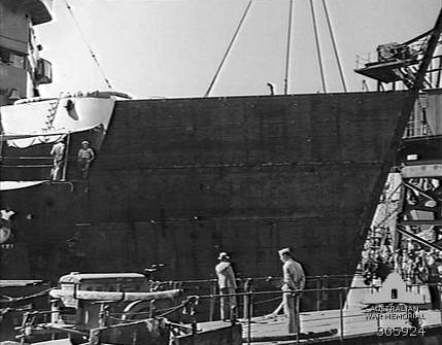
In Sydney, workers installed a temporary steel stub bow — enough to get her across the Pacific to a real shipyard. She sailed to Puget Sound Navy Yard in Bremerton, Washington, where a proper bow was finally built and fitted. New Orleans returned to service in October 1943 and fought in every major Pacific campaign from the Gilbert Islands to Okinawa.
182 men
The 182 sailors killed in the torpedo blast are listed on the memorials at the National Memorial Cemetery of the Pacific in Honolulu. Most of them were asleep in their bunks when the magazine detonated. They never knew what happened.
Turret No. 1 went to the bottom with them. So did the forward 8-inch guns, the anchor chain, the crew’s personal effects, letters from home that were in the mail room, and everything else forward of frame 40.
83 years later
On July 7, 2025, a team from the Ocean Exploration Trust aboard the research vessel Nautilus found the severed bow on the seafloor.
It was sitting upright at 675 meters in Iron Bottom Sound, the stretch of water between Guadalcanal and Tulagi where dozens of ships from both sides went down during the Solomon Islands campaign. The ROV cameras showed the anchor still in place, the hull plating intact, the paint still visible after eight decades underwater.
Iron Bottom Sound earned its name. At least 50 warships and transport vessels lie on the bottom. The New Orleans bow is one of them, sitting in the dark, 2,200 feet down, with the anchor chain still run out to the hawsepipe.
The National WWII Museum in New Orleans has a section of coconut log from the temporary bow on display. You can go see it.
Sources
- National WWII Museum: USS New Orleans coconut log artifact
- National WWII Museum: Severed bow discovery
- CNN: A torpedoed US Navy ship escaped the Pacific in reverse
- Naval History and Heritage Command: Bow discovery
- NPR: Lost WWII warship USS New Orleans found
- Wikipedia: USS New Orleans (CA-32)
- Naval Historical Society of Australia: The Salvage of USS New Orleans