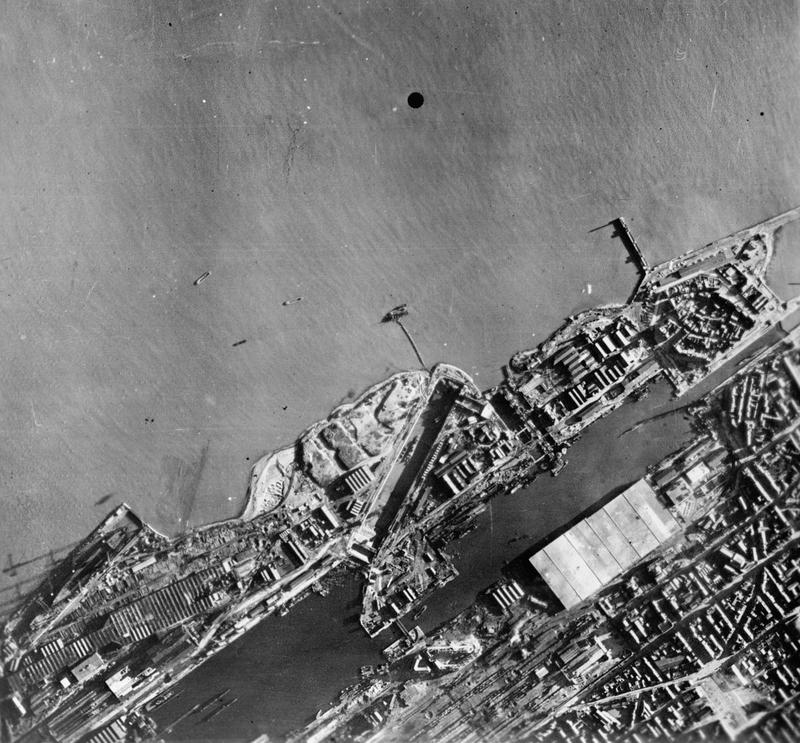
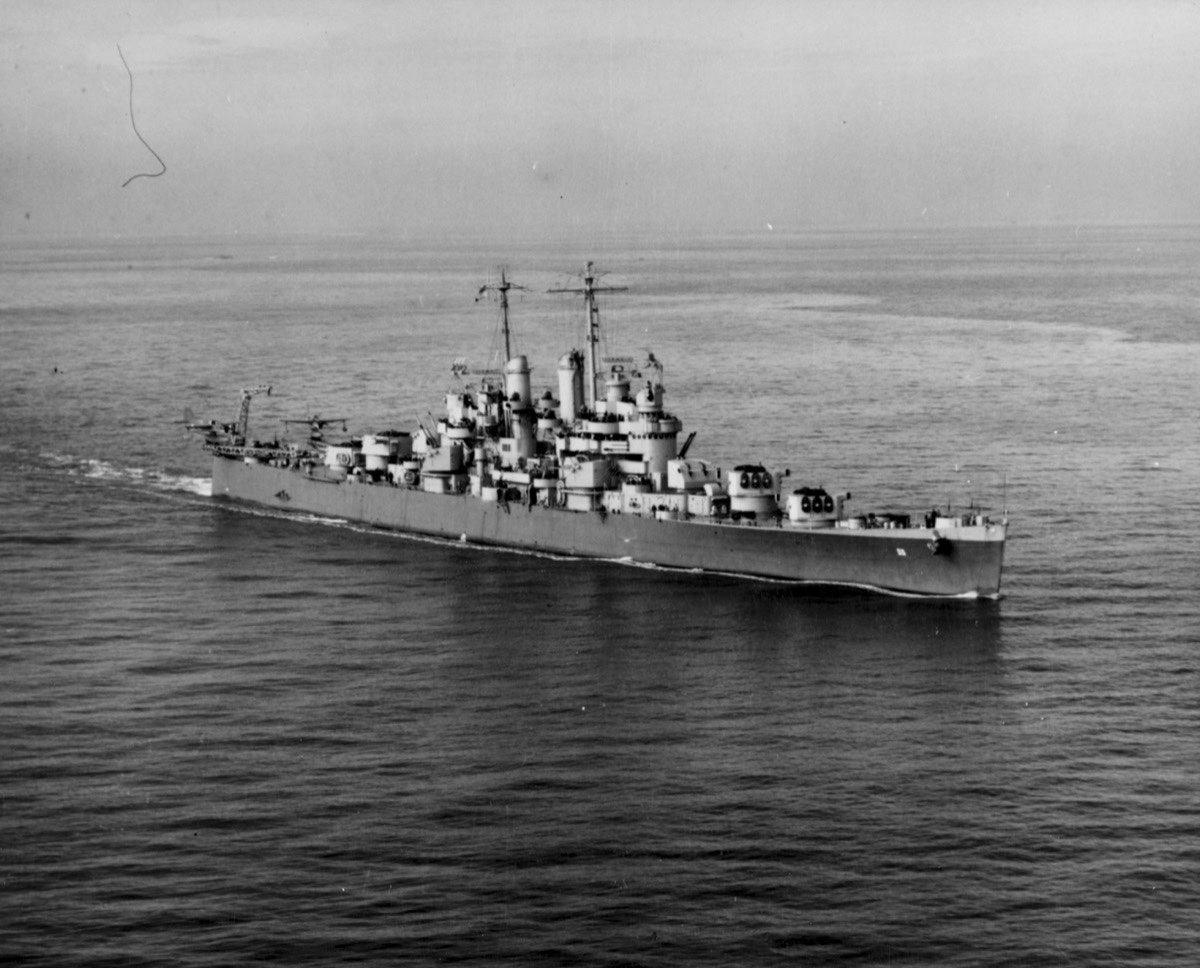
The Normandie Dock at St Nazaire was 350 meters long and 50 meters wide. It was the largest drydock in the world. It was also the only dock on the Atlantic coast big enough to service the German battleship Tirpitz.
If the dock could be destroyed, Tirpitz couldn’t risk a breakout into the Atlantic. Any battle damage would mean a return to Germany through waters the Royal Navy controlled. The strategic logic was simple. The execution was not.
The ship
HMS Campbeltown started life as USS Buchanan, a Wickes-class destroyer built at Bath Iron Works in 1918. She clocked 39.7 knots on her trials. By 1940 she was obsolete, one of 50 old destroyers traded to Britain for base leases.
The British cut her third and fourth funnels off and raked the remaining two at an angle. In the dark, from a distance, she looked like a German Type 23 torpedo boat. Her crew was cut from 158 to 75 to minimize casualties.
In the bow, behind the steel pillar supporting the forward gun mount, shipyard workers cemented 24 Mark VII depth charges containing 4.5 tons of amatol explosive. The charges were connected by Cordtex detonating cord and fitted with eight-hour time pencils.
The bow looked like a bow. Nobody inspecting the ship casually would find anything.
The approach
The raiding force left Falmouth on the afternoon of March 26, 1942: Campbeltown, 18 motor launches, a motor gun boat, a motor torpedo boat, and two escort destroyers. 612 men total. 269 Navy, 343 Commandos.
At 23:30 on March 27, RAF Bomber Command began diversionary raids over St Nazaire. Cloud cover made it ineffective. The bombers mostly circled without dropping.
At 01:22 on March 28, German searchlights lit up the convoy two miles from the dock. A signalman aboard the lead vessel flashed German recognition signals and transmitted a message claiming they were friendly boats under fire. The bluff bought six minutes.
At 01:28, the ruse failed. The White Ensign went up. Both sides opened fire.
The ramming
At 01:34, Campbeltown hit the southern gate of the Normandie Dock at 19 knots. Her bow crushed inward 36 feet and drove 33 feet onto the dock gate. The time pencils were already ticking.
Lieutenant Commander Stephen Beattie’s crew scuttled the ship and went ashore. Commando teams fanned out to destroy the dock’s pumping machinery, winding mechanisms, and gun positions. Many of the motor launches carrying additional commandos were destroyed by German fire before they could land.
The fighting ashore was fierce and brief. Colonel Augustus Newman led the commando force until they ran out of ammunition. Most of the raiders who survived the landing were captured.
The explosion
At noon on March 28, approximately ten hours after the ramming, the depth charges detonated.
A party of 40 senior German officers was aboard inspecting the wreck. They’d walked the deck, examined the bow, tried to figure out what the British had been thinking. At least 250 German soldiers, officers, and French civilians were killed in the blast. Some accounts put the number closer to 360.
The explosion destroyed the southern caisson and flooded the dock.
Two days later, torpedoes that MTB-74 had fired into the lock gates of the Old Entrance also detonated. The delayed blast triggered panic among German troops, who opened fire on their own men and French dockworkers.
The cost
Of 612 raiders, 169 were killed. 215 were captured. 228 made it back to England. Five escaped overland through Spain.
Five Victoria Crosses were awarded, the most for any single action in the war to that point. Sergeant Thomas Durrant, who manned his gun on Motor Launch 306 until he was mortally wounded, received his VC on the recommendation of the German naval officer who captured his boat.
Lieutenant Commander Beattie survived as a prisoner of war. He was liberated at Lubeck on April 10, 1945.
The dock
The Normandie Dock did not reopen until 1950. Tirpitz never attempted an Atlantic breakout. She was sunk by RAF Tallboy bombs at Tromso, Norway, on November 12, 1944, without ever having used the dock.
The Joubert Lock is still operational at St Nazaire. It is still the largest lock in France.
In 2024, workers found a hatch from HMS Campbeltown during maintenance on the dock structure. It had been embedded in the concrete for 82 years.
Sources
- St Nazaire Raid — Wikipedia
- HMS Campbeltown (I42) — Wikipedia
- A Bold Strategy: The British Raid on St. Nazaire — National WWII Museum
- Workers Find Rare Artifact From WWII’s “Greatest Raid” — The Maritime Executive
- Dorrian, James. Storming St Nazaire. Leo Cooper, 1998.