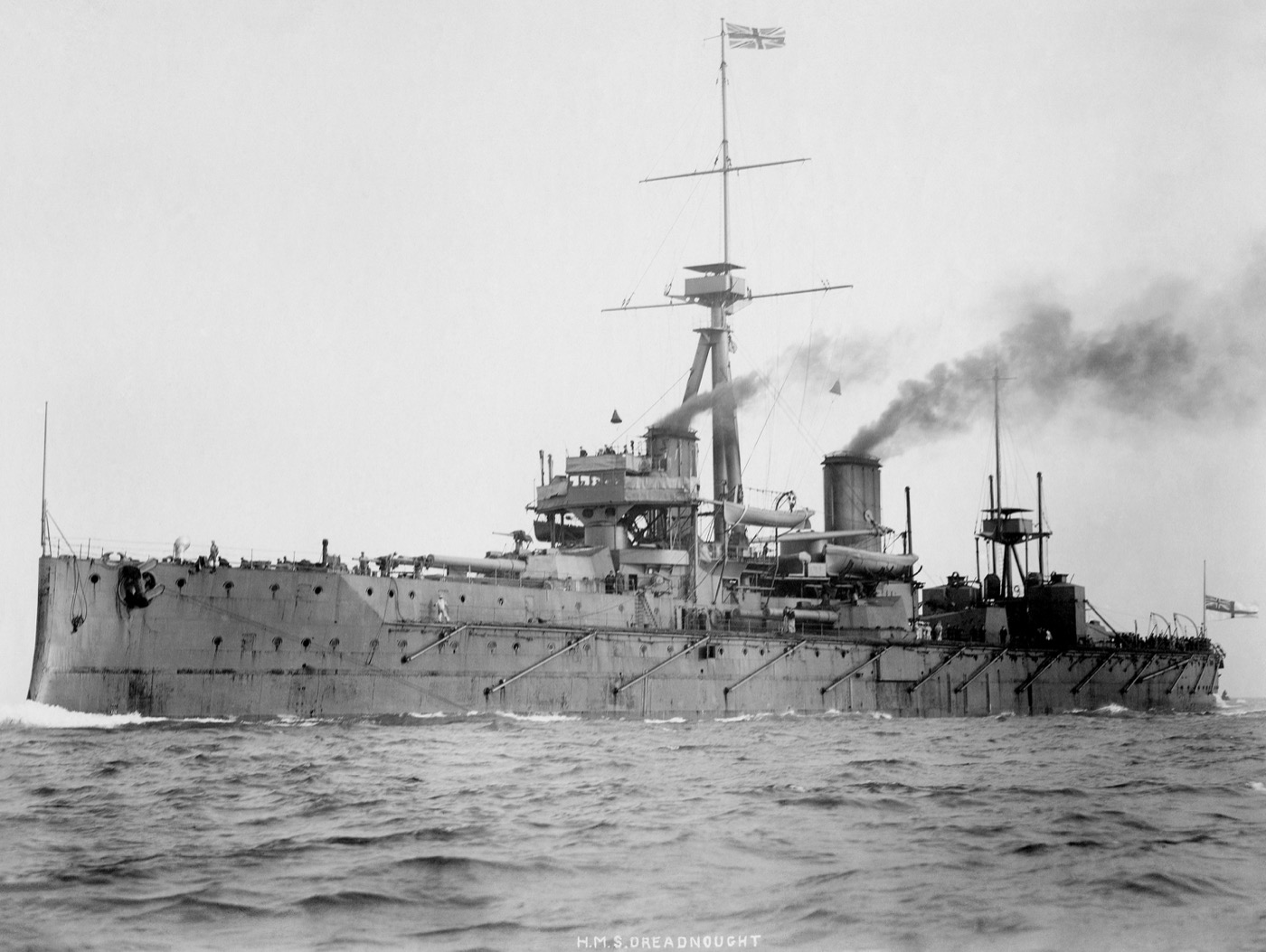
People use these words interchangeably. They shouldn’t. Battleships, cruisers, and destroyers were built for completely different jobs, carried different weapons, and died in different ways.
Here’s how they actually break down.
What is a battleship?
A battleship was the biggest thing afloat with the biggest guns afloat. That was its entire job description.
The HMS Dreadnought, launched in 1906, set the template: heavy armor, ten 12-inch guns, steam turbines for 21 knots. Every battleship built afterward followed the same formula. More armor. Bigger guns. More displacement.
By World War II, a standard battleship displaced 30,000 to 45,000 tons. The Japanese Yamato displaced 72,800 tons fully loaded and carried nine 18.1-inch guns — the largest naval rifles ever mounted on a ship. Each shell weighed 3,219 pounds.
Battleships existed to fight other battleships. Fleet admirals spent decades planning for the decisive gun battle where two lines of capital ships would slug it out at 20,000 yards. It happened exactly once in World War II, at Surigao Strait in October 1944.
The rest of the time, battleships bombarded shorelines and provided antiaircraft cover for carriers.
What is the difference between a cruiser and a destroyer?
Size, range, and purpose.
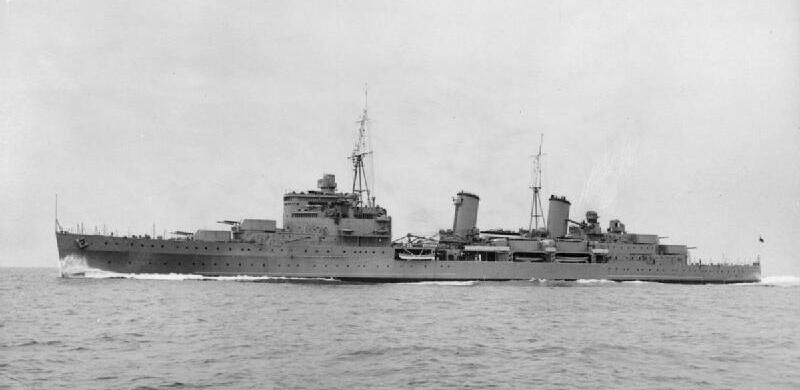
Cruisers were built to cruise. The name is literal. They had the range to cross oceans independently, the speed to outrun battleships, and enough firepower to handle anything smaller than themselves. A World War II cruiser displaced 8,000 to 15,000 tons, carried 6-inch or 8-inch main guns, and could sustain 32-33 knots.
They screened the fleet, hunted commerce raiders, escorted convoys, and showed the flag in distant waters. The Cleveland class — 27 ships, the largest cruiser class ever built — fought in nearly every major Pacific campaign from 1942 onward. Admiral Hipper, a German heavy cruiser, raided Allied shipping in the Atlantic and Arctic. Mogami cracked her own hull because Japan stuffed too many guns onto a treaty-legal displacement.
Destroyers were built to destroy torpedo boats. The full original name was “torpedo boat destroyer.” The Royal Navy coined the term in the 1890s when small, fast torpedo boats threatened to sink capital ships at close range. The solution: build something slightly larger, slightly faster, and give it guns that could kill torpedo boats before they got close.
By World War II, destroyers had evolved into the fleet’s utility players. They screened capital ships from submarines, launched torpedo attacks, hunted U-boats with depth charges, provided antiaircraft fire, rescued survivors, laid smoke, and did shore bombardment. A Fletcher-class destroyer — the most produced class in U.S. Navy history, 175 ships — displaced 2,500 tons and carried five 5-inch guns plus ten torpedo tubes.
Destroyers were fast, cheap relative to cruisers, and expendable. The Navy built them by the hundreds. They took the hardest jobs and the highest casualty rates.
Why did battleships become obsolete?
Aircraft carriers killed them.
The proof came on December 7, 1941, at Pearl Harbor, when Japanese carrier aircraft sank or damaged eight American battleships without a single Japanese surface ship firing a shot. Three days later, Japanese bombers sank HMS Prince of Wales and HMS Repulse off Malaya — two capital ships caught without air cover in open water.
By 1944, the pattern was set. At Leyte Gulf, the Yamato’s sister ship Musashi absorbed 17 bombs and 19 torpedoes from carrier aircraft before sinking. Yamato herself was sunk in April 1945 by roughly 400 American aircraft. She never got within gun range of an enemy ship.
A single aircraft carrier could project striking power over hundreds of miles. A battleship could project it over 25 miles, max. The math was obvious.
The last battleships in active service were the four Iowa-class ships, recommissioned by the U.S. Navy in the 1980s and used for shore bombardment in the Gulf War. USS Missouri fired the last battleship rounds in combat in February 1991. All four were decommissioned by 2012.
What is the difference between a heavy cruiser and a light cruiser?
Gun caliber. That’s it.
The 1930 London Naval Treaty drew the line: cruisers with guns larger than 6.1 inches but not exceeding 8 inches were “heavy cruisers” (Category A). Cruisers with guns of 6.1 inches or smaller were “light cruisers” (Category B).
In practice, heavy cruisers were slightly larger and carried eight to ten 8-inch guns. Light cruisers carried twelve to fifteen 6-inch guns. The Cleveland class was a light cruiser with twelve 6-inch guns. USS Wichita was a heavy cruiser with nine 8-inch guns.
The distinction mattered for treaty accounting — every nation had tonnage limits for each category — and for tactical doctrine. Heavy cruisers hit harder per shell. Light cruisers threw more shells per minute. Both could outrun a battleship and outgun a destroyer.
Japan ignored the treaty limits almost immediately. Mogami was declared a light cruiser at 8,500 tons. She actually displaced over 11,000 tons and was designed to swap her 6-inch turrets for 8-inch guns at the first opportunity. Which Japan did.
Are there still cruisers in service today?
Barely.
The U.S. Navy operates the last cruisers in any Western navy: the Ticonderoga class, 27 originally built, now being phased out. These are 9,800-ton guided-missile cruisers built around the Aegis combat system. Three — USS Gettysburg, USS Chosin, and USS Cape St. George — received service life extensions into 2029-2030. The rest are being retired.
Russia’s Kirov-class battlecruisers — 28,000 tons, nuclear-powered — technically still exist. One, Pyotr Velikiy, remains nominally active. Another, Admiral Nakhimov, has been in refit since 1999.
China operates two Type 055 “destroyers” that displace 13,000 tons. Most Western analysts call them cruisers. China calls them destroyers. The naming game hasn’t changed much since Japan lied about Mogami.
The destroyer has absorbed most of the cruiser’s old jobs. Modern Arleigh Burke-class destroyers displace 9,700 tons — nearly identical to the Ticonderoga cruisers they’ll outlast. The distinction between “cruiser” and “destroyer” in 2026 is mostly bureaucratic.
Battleships are gone. Cruisers are almost gone. Destroyers inherited everything.