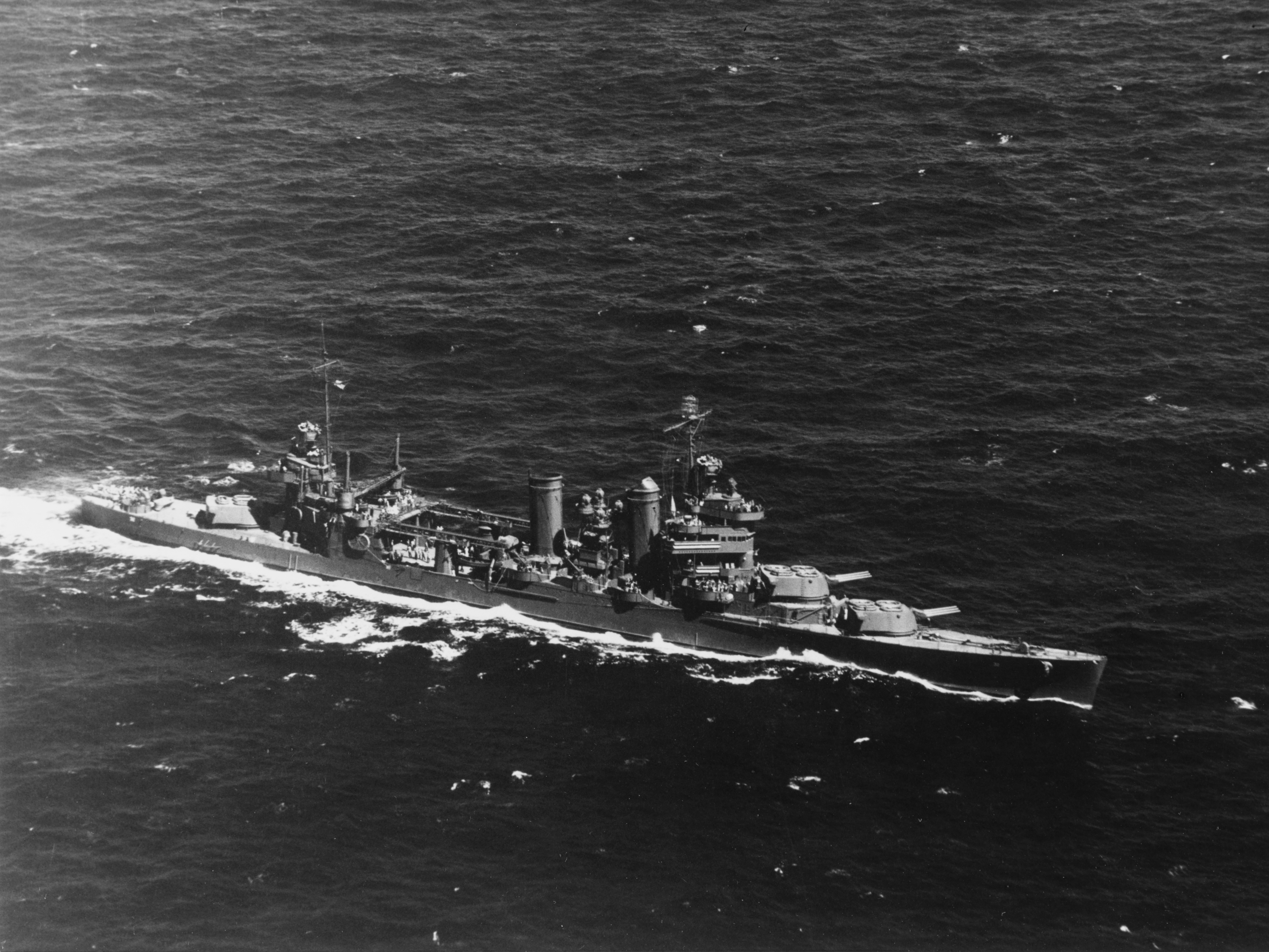
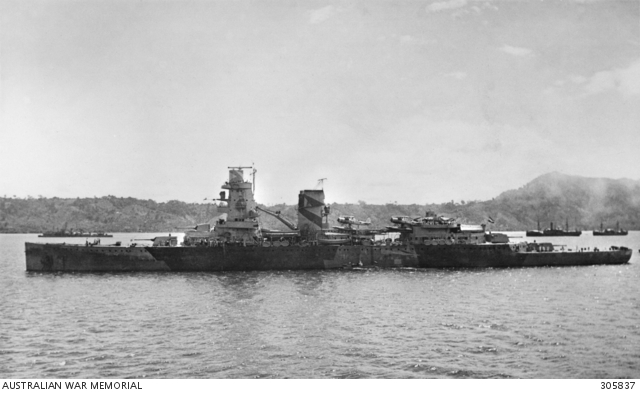
At 07:48 on December 7, 1941, USS New Orleans was drawing all her power from the dock at Navy Yard Berth 16. Her boilers were cold. She was having a turbine lifted, which meant her own electrical power was off. When the first bombs hit and the yard power failed, every light on the ship went out.
No electricity meant no ammunition hoists. No hoists meant no shells at the guns. The 5-inch/25-caliber anti-aircraft rounds weighed 54 pounds each.
Someone broke the locks on the ammunition ready boxes. The magazine keys were missing. Engineers started raising steam in the dark, working by flashlight. Every available man fell into line.
The phrase
Chaplain Howell Maurice Forgy was 33 years old, a Presbyterian minister from Philadelphia, 6’2” and 200 pounds. He’d arrived in the Navy in 1940 after building a church in Murray, Kentucky, from nine Presbyterians and very little money. His rank was Lieutenant, junior grade.
Under the rules of war, a chaplain is a noncombatant. Forgy couldn’t handle weapons or ammunition. So he walked along the ammunition passing line, where sailors were tying ropes to the metal shell cases, hauling them up the dead hoists by hand, boosting them onto each other’s backs, and carrying them up two flights of ladders to the guns.
Lieutenant Edwin F. Woodhead was in the line when he heard a voice behind him: “Praise the Lord and pass the ammunition.” He turned and saw Forgy walking toward him, patting men on the back as he went.
The phrase spread through the ship. Then through the fleet. Then through the country.
The song
Frank Loesser, who would later write Guys and Dolls, saw a newspaper clipping about the phrase. The clipping attributed it to Captain William Maguire, the senior fleet chaplain for the Pacific Fleet. Maguire was a Catholic chaplain who had been on a dock at Pearl Harbor that day, not aboard New Orleans. Loesser wrote the song and credited Maguire.
Loesser himself didn’t think it would work. He believed Americans didn’t want a real war song. He was wrong.
Kay Kyser’s Orchestra recorded it in 1942. It went to No. 1. The Merry Macs took their version to No. 8. The Jubalaires hit No. 10 on the R&B chart. The song sold over 450,000 copies in two months and sat on Variety’s best-seller list for three. Loesser donated his royalties to the Navy Relief Society.
The problem was that the Navy had kept New Orleans’s crew from talking to the press. Reporters kept attributing the phrase to other chaplains. Maguire, when asked, said he couldn’t recall saying it. The crew of New Orleans pushed Forgy to come forward, but Forgy wouldn’t bite. He told reporters the phrase “should remain a legend, rather than be associated with any particular person.”
His officers disagreed. They arranged a press meeting with the crew. On October 31, 1942, the Navy identified the actual speaker: Lieutenant Howell Forgy, age 34, chaplain aboard USS New Orleans. His shipmates confirmed it. Maguire didn’t contest it.
A Pittsburgh Post-Gazette article from January 1943 pointed out that a similar line appears in John Ford’s 1939 film Drums Along the Mohawk. Whether Forgy had seen the film is not recorded. Whether it matters is debatable. He said it on a burning ship with Japanese planes overhead. That’s the version people remember.
Years later, Forgy appeared on the game show I’ve Got a Secret and told the whole thing flat:
“We were tied up at 1010 dock in Pearl Harbor when we were attacked. We were having a turbine lifted, and all of our electrical power wasn’t on, so when we went to lift the ammunition by the hoist, we had to form lines of men, form a bucket brigade, and we began to carry the ammunition up through the quarterdeck into the gurneys. I stood there and directed some of the boys down the port side and some down the starboard side, and as they were getting a little tired, I just happened to say, ‘Praise the Lord and pass the ammunition.’ That’s all there was to it.”
That’s all there was to it. A tired man said a thing. Frank Loesser made it a hit. The Navy spent ten months arguing about who said it.
Forgy published a memoir in 1944: …And Pass the Ammunition. He retired in 1946 as a Commander. He died on January 20, 1972, two days after his 64th birthday.
What New Orleans did next
The ship survived Pearl Harbor with 16 shrapnel holes and no casualties. She went on to Coral Sea, where she rescued 580 sailors from the sinking USS Lexington. Then Midway. Then Guadalcanal.
Then Tassafaronga.
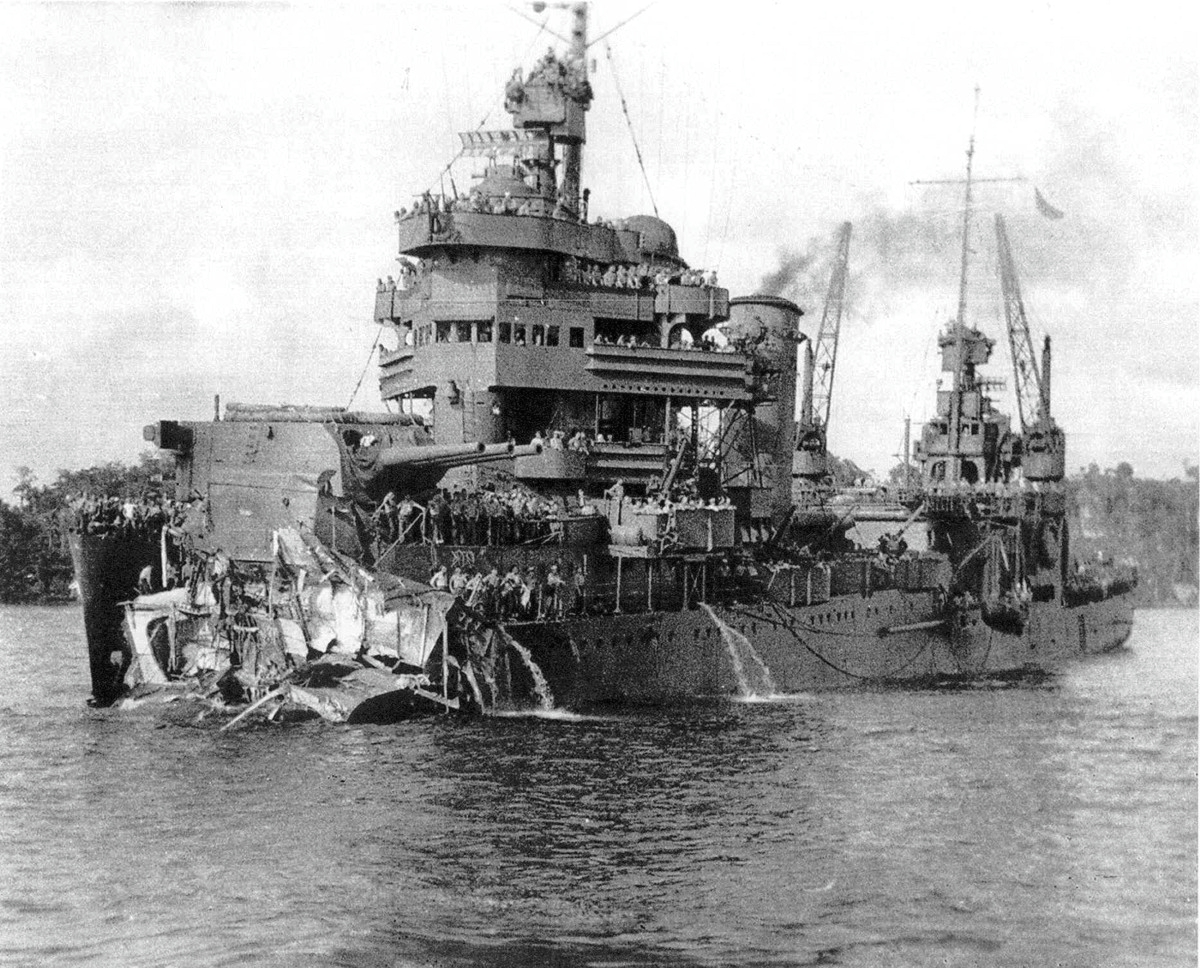
On the night of November 30, 1942, a Japanese Type 93 torpedo hit forward of Turret No. 2 and detonated the forward magazines. The explosion tore off 150 feet of the ship, nearly a third of her length. Over 180 men were killed in the blast.
Three damage control officers stayed at their posts while toxic fumes spread through the ship. Lieutenant Commander Hubert Hayter gave his gas mask to an enlisted sailor who didn’t have one, then kept directing operations until he collapsed. Lieutenant Richard Haines and Ensign Andrew Forman died beside him. All three received posthumous Navy Crosses. All three had destroyer escorts named after them: USS Hayter, USS Haines, USS Foreman.
The ship couldn’t sail forward. The crew steered her backwards to Tulagi, then backwards 1,800 miles to Sydney, arriving on Christmas Eve. At Tulagi, they built a temporary bow from coconut logs.
Still there
New Orleans earned 17 battle stars. She was scrapped in 1959.
Her bow sat on the floor of Iron Bottom Sound for 83 years. On July 7, 2025, the Ocean Exploration Trust found it at 675 meters, using a remotely operated vehicle aboard E/V Nautilus. The expedition was led by Robert Ballard. The ROV imaged the anchor, still legible with “Navy Yard” stamped into the metal.
The bow is still down there. So are the men who were standing near Turret No. 2.
Sources
- USS New Orleans (CA-32) — Wikipedia
- USS New Orleans Action Report — Naval History and Heritage Command
- Praise the Lord and Pass the Ammunition — Wikipedia
- Lost Severed Bow of USS New Orleans Discovered — NHHC
- CDR Howell Maurice Forgy — Find a Grave
- Praise the Lord and Pass the Ammunition — War History Online