USS Enterprise, CV-6, earned 20 battle stars in the Second World War. No other American warship earned more. Her aircraft and guns claimed 911 Japanese planes shot down and 71 ships sunk.
Japan, for its part, announced her sunk three separate times.
Her crew adopted the result as a nickname. She became the Grey Ghost. The Big E kept turning up at battles she had officially not survived.
What no Japanese communiqué managed, one pilot did on a single morning in May 1945. And what no pilot managed, a peacetime budget did in 1958.
A carrier that kept coming back
Enterprise was a Yorktown-class carrier, built by Newport News Shipbuilding. She was laid down on July 16, 1934, launched on October 3, 1936, and commissioned on May 12, 1938. She displaced 19,800 tons standard and made 32.5 knots.
She fought at Midway and off Guadalcanal, and she was hit hard twice in the Solomons.
At the Eastern Solomons on August 24, 1942, she took three direct bomb hits and four near misses. 74 men died and 95 were wounded.
At Santa Cruz on October 26, 1942, two more bombs hit her. 44 died and 75 were wounded.
Each time, she was repaired and came back. Sources agree Japan reported her sunk three times. They do not agree on which three occasions, and we could not pin down the dates in two independent sources, so we will not guess. The pattern matters more than the list: Japanese aircrews returning from a carrier strike often claimed more than they got, and Enterprise kept outliving the claims.
The pilot who got through
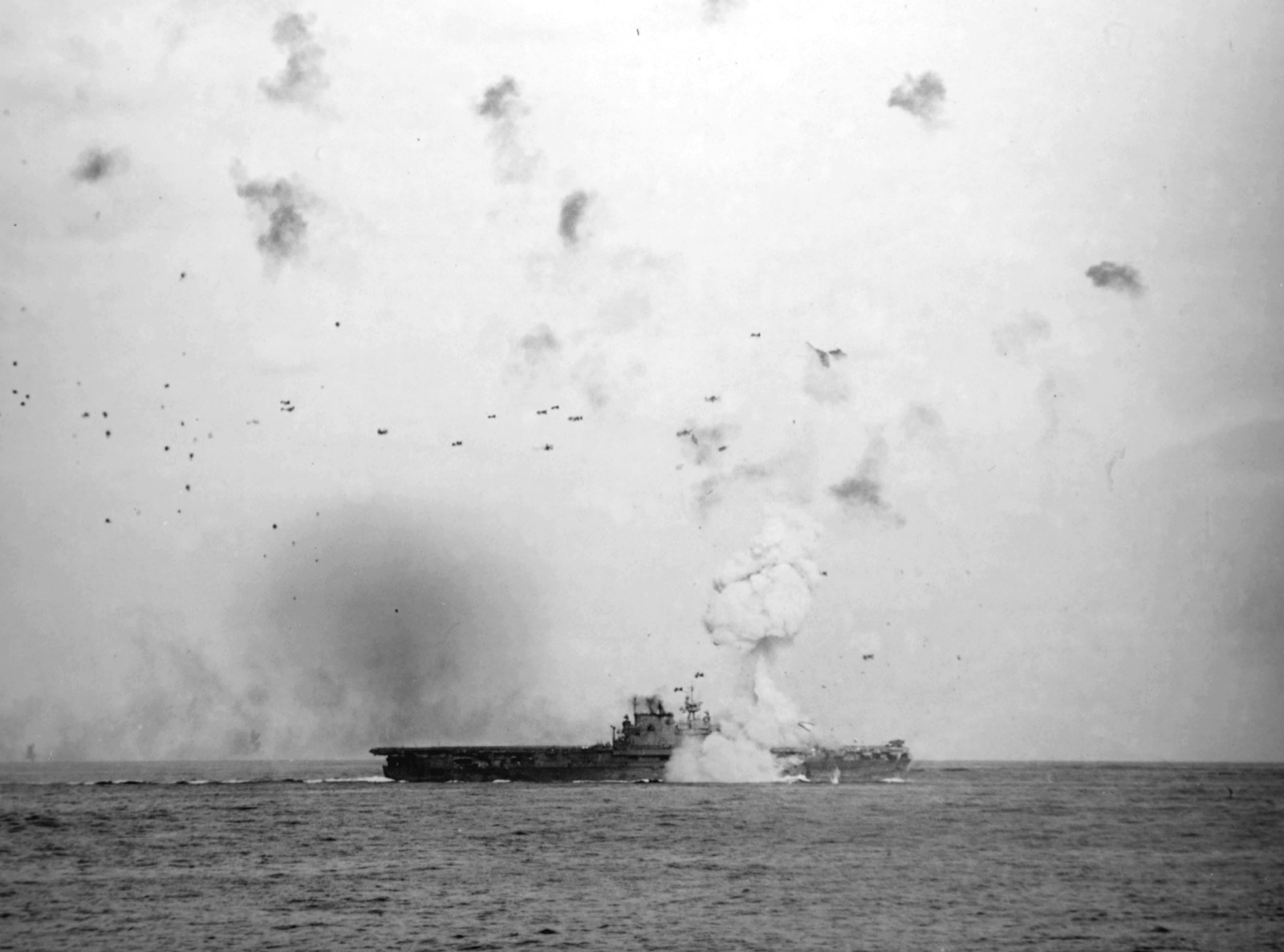
On the morning of May 14, 1945, Enterprise was operating off Kyushu in support of the Okinawa campaign.
At 5:30 that morning, Lieutenant (junior grade) Shunsuke Tomiyasu took off from Kanoya Air Base in southern Kyushu. He led the 6th Tsukuba Squadron of the Kamikaze Special Attack Corps: 14 Zero fighters, each carrying a 500-kilogram bomb.
Tomiyasu worked through the antiaircraft fire and came at the carrier as she turned. It looked as if he would overshoot. He rolled his Zero onto its back and dove into the flight deck just aft of the forward elevator.
The bomb went off below the deck. The explosion threw most of the forward elevator into the air. How high depends on who you read. Wikipedia and the kamikaze histories say more than 400 feet. Pacific Wrecks says approximately 700 feet.
The casualty count varies too. The most common figure is 14 killed and 68 wounded. One Japanese-language-based account says 13 killed. Pacific Wrecks gives 34 wounded. All agree on the main point: damage control had the fires out in about 30 minutes, the ship stayed in formation, and the damage was bad enough that she had to return to the United States for repairs. Enterprise was out of the war.
The name that took 50 years
After the crash, his rank came from the insignia on his flight suit. In one pocket were name cards. They were translated as “Tomi Zai,” and that is the name the Americans used for him for almost 50 years.
The correction came from the other side. Kan Sugahara, a graduate of the 77th class of the Imperial Japanese Naval Academy at Etajima, went through Japanese records of navy lieutenants (junior grade) who died in special attacks on May 14, 1945. He matched the kanji on the cards to Tomiyasu’s name, and matched the time of the hit to Tomiyasu’s sortie time from Kanoya.
So the carrier Japan had sunk three times on paper was actually stopped by a man the US Navy had filed under the wrong name.
Beaten by the bill
Enterprise went into the New York Naval Shipyard for inactivation in January 1946 and was decommissioned on February 17, 1947.
The plan was to keep her. In 1946 she was slated to become a memorial and museum in New York. The project was suspended in 1949. Her veterans formed the USS Enterprise CV-6 Association, and Fleet Admiral Halsey lent it his name and his effort. They tried to raise the money to take her off the Navy’s hands.
They failed. Accounts give different price tags, from about one million to two million dollars, for buying, moving and keeping the ship. Whatever the exact number, the Association never got near it. The Navy struck her from the list on October 2, 1956.
On July 1, 1958, Enterprise was sold to the Lipsett Corporation of New York City. She was broken up at Kearny, New Jersey, and the job was finished by May 1960.
Smaller and older ships made it. The cruiser Olympia, a veteran of 1898, was saved in Philadelphia (her later career is in our story on the Unknown Soldier). The most decorated American warship of the Second World War went to the breakers. Her opponents mostly kept their ships the other way, on the seabed: Yamato still lies in the East China Sea southwest of Kyushu, not far from the airfield Tomiyasu flew from.
What survived
The man who directed the dismantling was Henry Hoffmann, a resident of River Vale, New Jersey. He saved the stern nameplate, the big steel letters that spelled her name across her stern, and brought it home to his township.
It stood for decades behind the center field fence of a Little League field. In December 2000, through the efforts of local VFW member Edward Carter, it moved to River Vale’s Veterans Memorial Park. Sources disagree on its weight: Pacific Wrecks and Wikipedia call it a one-ton, sixteen-foot plate, while the Battleship New Jersey museum says nearly half a ton.
In 2025 River Vale handed it to the Naval History and Heritage Command. On October 9, 2025, it was unveiled on the pier of the Battleship New Jersey Museum and Memorial at 62 Battleship Place in Camden, New Jersey. It is meant to move on to the National Museum of the United States Navy now under construction in Washington.
The ship Japan sank three times on the radio is now a single steel sign on a pier in Camden, a short drive down the New Jersey Turnpike from the yard where she was cut up.