Sunday morning, December 7, 1941. The Pacific Fleet’s battleships were in Pearl Harbor. Only one of them got underway that day.
The eighth was USS Nevada. She was the oldest battleship in the row, launched at Quincy, Massachusetts, in July 1914. Her captain, Francis W. Scanland, was ashore. So were most of her senior officers.
She cast off anyway. Then her crew deliberately put her on the beach. Five years later the Navy painted her orange and dropped an atomic bomb on her. That missed too.
A rump crew and two warm boilers
Nevada was moored off Ford Island at the end of Battleship Row, near USS Arizona. What mattered most was steam. Battleships in harbor on a weekend often ran on a single boiler. A cold battleship takes hours to raise steam. Nevada had a second boiler lit that night. Accounts differ on why. One version says an officer wanted to switch boilers in the morning. Either way, she had pressure when the bombs started falling.
A Japanese aerial torpedo hit her port bow early in the attack. Nevada took on water and a list, and her gunners kept firing.
Below decks, Chief Machinist Donald K. Ross ran the forward dynamo room as it filled with smoke and steam. He ordered his men out and worked the station alone until he passed out. He was revived, went back, and was carried out again. He then worked the after dynamo room until told to leave. On April 18, 1942, Admiral Chester Nimitz gave him the Medal of Honor, the first awarded in the Second World War.
On deck, Chief Boatswain Edwin J. Hill took the line-handling party onto the quays at Ford Island, under strafing, and cast off the mooring lines. Then he and his men swam back to the ship.
Who was actually conning Nevada as she backed clear is less certain than the usual account suggests. The senior officer aboard was Lieutenant Commander Frank Thomas. Commander Jack D. Bruce, who studied the morning, wrote that the story of the “rump crew” had “never been fully or accurately told” and that the stories “are often inaccurate and sometimes misleading.” Even the order of who took charge, and when, is disputed.
What is not disputed: roughly 45 minutes after the attack began, a battleship with a hole in her bow was moving down the channel, past the burning Arizona.
The beach, on purpose
For the second wave of Japanese aircraft, a moving battleship in a narrow channel was the best target in the harbor.
There was a calculation behind the bombing, whether or not the Japanese pilots made it explicitly. The channel out of Pearl Harbor is the only way in or out. Sink a 27,500-ton battleship in it, and the Pacific Fleet’s base is corked for months.
Nevada was hit by at least six bombs. Fires spread around her bridge and forward superstructure. She was going down by the head.
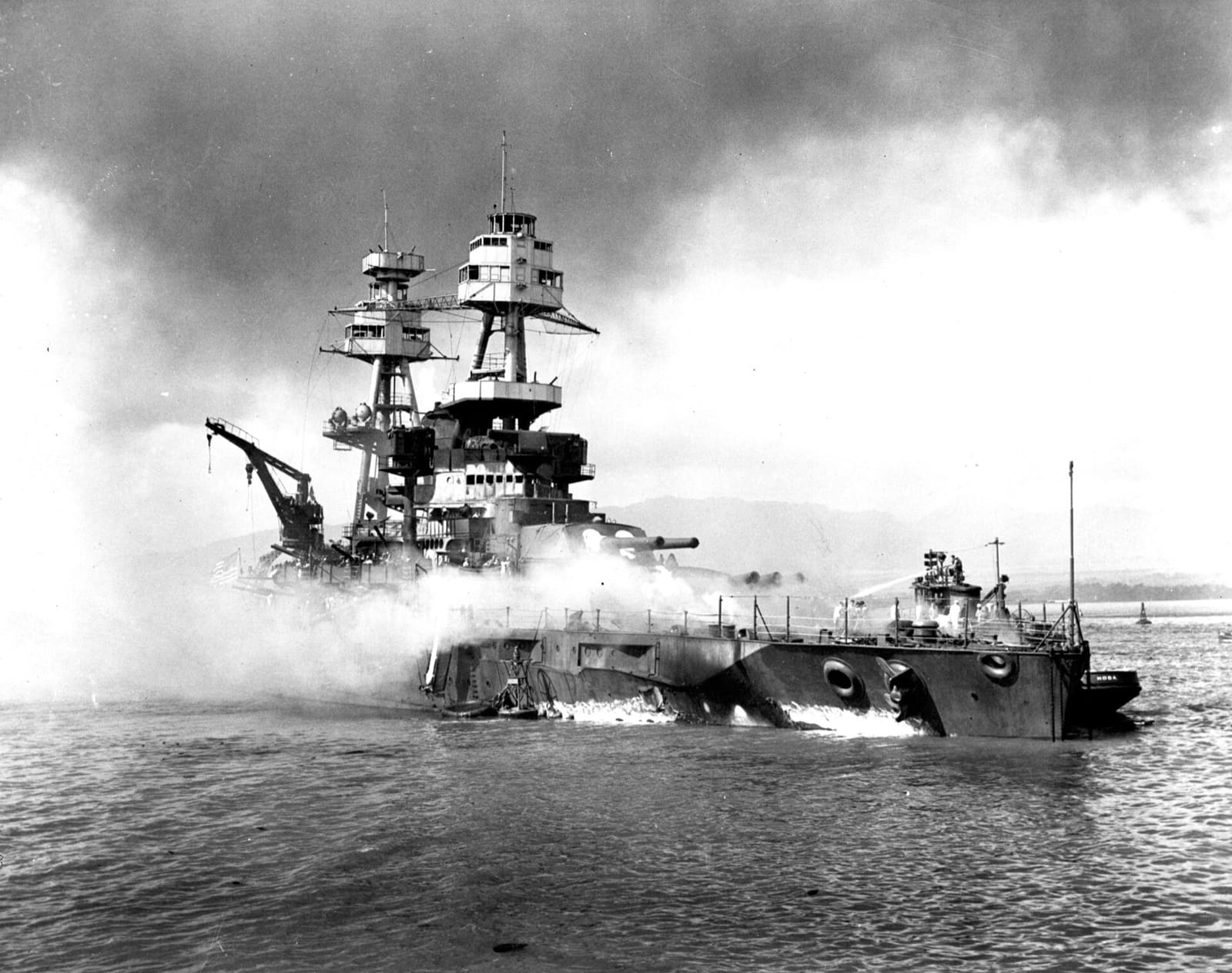
Her crew put her aground at Hospital Point rather than risk her sinking in the channel. A National Archives photograph timed at 9:25 that morning shows her nosed into the shore, smoke pouring off her forward structure, with the tug Hoga alongside fighting the fires.
Chief Boatswain Hill was on the forecastle trying to let go the anchors when several bombs exploded around him. He was blown overboard and killed. His Medal of Honor was awarded posthumously.
Nevada did not stay at Hospital Point. With the tugs Hoga and Avocet helping, she was moved and grounded again, stern first, across the channel at Waipio Point. She was clear of the fairway. The harbor stayed open.
Nevada lost 60 men killed and 109 wounded.
Back from the mud
The Navy refloated her, repaired her and sent her back to war.
She then went to almost every kind of war the US Navy fought. She covered the landings at Attu in May 1943. She was off Utah Beach in Normandy on June 6, 1944, which made her the only US battleship present both at Pearl Harbor and on D-Day. She shelled southern France that August, then crossed back to the Pacific for Iwo Jima and Okinawa.
Off Okinawa, on March 25, 1945, a kamikaze hit her. Eleven men died and 49 were wounded.
By the end of the war she was the oldest battleship the Navy had in service. That made her expendable.
Ground zero, painted orange
Operation Crossroads gathered more than 90 ships in the lagoon at Bikini Atoll in the Marshall Islands. The Navy wanted to know what an atomic bomb does to a fleet. Among the targets was the German cruiser Prinz Eugen.
Nevada was chosen as the aiming point for the first test, Able. She was painted orange so the bombardier could find her from altitude.
On July 1, 1946, the B-29 “Dave’s Dream” dropped the bomb. It missed. The figures disagree on by how much. One account puts the burst 980 feet short and 1,870 feet to the left of Nevada. The Atomic Heritage Foundation says it went off “between 1,500 and 2,000 feet” from the target ship, about half a mile. Either way, Nevada was not where the bomb went off. Five other ships sank.
Nevada was damaged and stayed afloat. Analysts concluded that a full crew aboard would have taken a lethal dose of radiation.
On July 25 came Baker, an underwater burst that threw up a column of contaminated water over the lagoon. Nevada survived that too. She was now too radioactive to keep and too stubborn to sink. She was decommissioned on August 29, 1946, and towed back to Pearl Harbor.
Too tough to sink, then sunk
On July 31, 1948, the Navy took her out to sea off Oahu as a target. The battleship USS Iowa and two other ships fired on her. She stayed up. An aerial torpedo amidships finally put her under.
For 72 years nobody knew exactly where she was. In May 2020 the archaeology firm SEARCH, Inc. and robotics company Ocean Infinity announced they had found her with an autonomous underwater vehicle. She lies about 65 nautical miles southwest of Pearl Harbor at a depth of more than 15,400 feet.
The cold and the dark have preserved her paint. On her stern, the robot photographed a faded “36,” her hull number, and a “140” painted on a structural frame so damage inspectors at Bikini could report where they found it. An inscription is still legible over a hatch to one of her 5-inch gun handling rooms.
Back in Pearl Harbor, the spot where her crew ran her aground is still called Hospital Point. Every ship leaving the harbor passes it.
Sources
- USS Nevada (BB-36), Wikipedia
- Chief Boatswain Edwin J. Hill, Naval Historical Center Online Library (HyperWar mirror)
- This Day in History: Donald Ross, hero of Pearl Harbor, Tara Ross
- Operation Crossroads, Atomic Heritage Foundation
- USS Nevada (BB-36), This Day in Aviation
- Wreck of renowned USS Nevada uncovered near Pearl Harbor, Military History Matters