Just before 08:00 on Sunday, December 7, 1941, part of USS Arizona’s band was on the fantail under the white awning. They had instruments out. Their job that morning was to play while the national ensign went up.
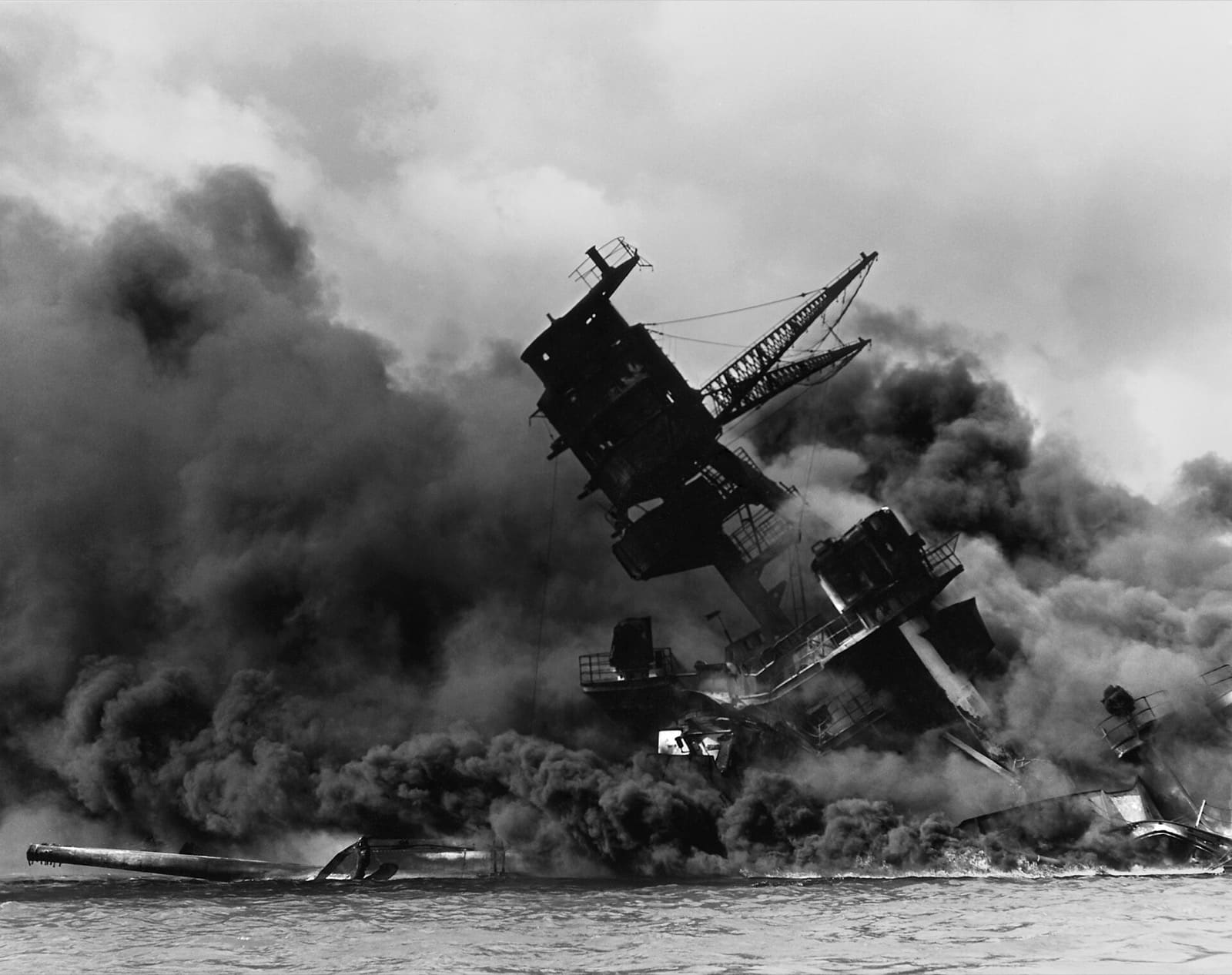
A few minutes later all 21 of them were dead. So were 1,156 other men aboard. Arizona lost 1,177 sailors and Marines, close to half of everyone the United States lost at Pearl Harbor that day.
The band’s story gets told every December. Most versions get the important part wrong.
The story everyone tells
The usual version goes like this. On the night of December 6, Arizona’s band competed in the fleet’s “Battle of Music” at Bloch Arena. They did well, so they were allowed to sleep in on Sunday. When the bombs came, they were below decks in their bunks.
It is a neat story, and the people who keep the ship’s records say it isn’t true. USSArizona.org, which has run the ship’s memorial site since 1999, calls the sleep-in story a myth that spread through national television coverage.
Here is what the record shows instead.
The Battle of Music was a 1941 contest between Navy and Marine bands, held at Bloch Arena on alternate Saturday nights through the fall. Seventeen Navy bands and one Marine unit took part. Arizona’s band, officially Navy Band Unit 22, qualified for the final in November.
On December 6 they did not play. That night’s semifinal featured the bands of Argonne, Pennsylvania, Tennessee and the Submarine Base, which was filling in for Detroit. Pennsylvania won. Arizona’s band went to watch.
The final was scheduled for December 20, 1941. It never happened.
Where the band actually was
The band had only existed since May 1941. Its leader was Musician First Class Frederick William Kinney, 36, a baritone player born in Robinson Creek, Kentucky. He had trained at the U.S. Navy School of Music and took over the band when he graduated. He had 20 men under him.
Like every musician in the fleet, they had a second job. In combat, a battleship band handled ammunition. Arizona’s men were assigned to the third deck, where they made sure the powder bags rode the electric hoists up to the guns of Turret No. 2. Each bag weighed about 75 pounds.
So when the attack started, the band put down their instruments and went below. They went to the most dangerous compartment on the ship.
A Japanese bomb of roughly 1,760 pounds hit Arizona’s forward deck and set off the magazines below. The memorial’s own spokesman put it plainly: it was not the bomb that made the giant explosion, it was Arizona’s own ammunition, hundreds of thousands of pounds of it, going up at once.
The band was standing next to that ammunition. Of the 21, only three bodies were recovered, from the water: Scruggs, Cox and Shaw. The rest are still in the ship.
History.com describes it as the only time in U.S. military history that an entire band was lost in action.
After the attack, the surviving bands voted on the contest. They gave the trophy to Arizona and renamed it the Arizona Trophy, with the 21 names inscribed.
Black tears
More than 900 of Arizona’s dead were never recovered. In 1962 the white memorial was dedicated over the hull. About 1.8 million people a year now stand on it.
When they look down, many of them see oil.
Arizona carried around 1.5 million gallons of Bunker C fuel oil in December 1941. The National Park Service estimates around 500,000 gallons are still inside. It comes up a few drops at a time, somewhere between a few quarts and roughly a gallon a day depending on whose figure you trust, and spreads into rainbow sheens on the surface. Visitors call it the black tears of the Arizona.
If you’ve read about USS New Orleans at Pearl Harbor, you know the attack was mostly fought by men hauling ammunition by hand. On Arizona, the men hauling ammunition never had a chance.
Coming back aboard
In 1982, the Navy began letting Arizona survivors do something unusual. A man who had served aboard on December 7, 1941, could have his cremated remains placed inside the wreck, with the shipmates he had left behind.
The first was Gunner’s Mate Second Class S. M. Teslow, in 1982. Navy and Park Service divers carry each urn down and place it inside the barbette of Turret No. 4, the round armored base that once held the aft guns. Each ceremony has a committal service, a rifle salute, Taps and a flag for the family.
Other Pearl Harbor veterans can have their ashes scattered in the harbor. Only Arizona men go into Arizona.
The most recent, and very likely the last, was Harvey Milhorn.
On December 7, 1941, Milhorn was a 20-year-old gunner’s mate at a .50-caliber machine gun at the rear of the ship. When the forward magazine went, the blast threw him into a handrail and burned his clothes off. His gun crew died, including his best friend, Russ Tanner. Milhorn got to the fantail, went over the side and swam through the oil to Ford Island.
He later retired as a lieutenant. He died in 2002 at 80.
Then his family found a letter in his papers. In the 1990s he had filed a request to be interred in the Arizona. “He never talked about the reason why,” his granddaughter Rachel Yarasavich said, “other than we just assumed, Russ Tanner, his best friend, was killed on the boat.”
His ashes went into the barbette at 4 p.m. on December 7, 2021, the 80th anniversary of the attack, nineteen years after he died. He was the 45th survivor to go home to the ship.
Every man who was aboard that morning is now gone. The list of 45 is almost certainly closed. Arizona was one of the worst single-ship losses the U.S. Navy ever suffered, and six months later the carriers that weren’t in the harbor that Sunday won at Midway.
What you can see today
Take the boat from the Pearl Harbor visitor center to the USS Arizona Memorial. Stand over the hull and look for the round top of Barbette No. 4 just under the surface. Forty-five survivors are inside it. Watch long enough and a drop of oil will come up from somewhere below them.
Sources
- USSArizona.org: USS Arizona Band, Where They Really Were
- USS Arizona Operation 85: MUS1c Frederick William Kinney
- Pearl Harbor National Memorial (NPS): USS Arizona Interments
- TIME: What Happened to the USS Arizona After Pearl Harbor?
- History.com: 5 Facts About Pearl Harbor and the USS Arizona
- Honolulu Star-Advertiser: Pearl Harbor survivor to get final wish
- PearlHarbor.org: The Fate of the USS Arizona Band