The Battle of Leyte Gulf ran from 23 to 26 October 1944. It is often called the largest naval battle in history, and it was really four battles: the Sibuyan Sea, Surigao Strait, Samar and Cape Engaño.
Japan committed nearly every major warship it had left. The plan was simple and a little desperate. One force would act as bait. While the Americans chased it, two others would get into Leyte Gulf and shoot up the invasion shipping.
The bait was a carrier force under Vice Admiral Jisaburo Ozawa. Its carriers were real. The planes were mostly missing, because Japan’s trained aviators had already died in earlier battles. Ozawa’s job was to be seen.
A message that said “will be formed”
On the afternoon of 24 October, Admiral William F. Halsey Jr., commanding the Third Fleet, sent out a battle plan. Task Force 34 “would be formed”: four battleships, two heavy cruisers, three light cruisers and fourteen destroyers, ready to block San Bernardino Strait.
Vice Admiral Thomas Kinkaid, commanding the Seventh Fleet off Leyte, read the intercept and assumed Task Force 34 existed and was guarding the strait. It did not. “Would be formed” was a plan, not an order.
That evening Halsey learned where Ozawa’s carriers were. He took everything north: the fast carriers and the battleships that would have made up Task Force 34. San Bernardino Strait was left open.
Through it, during the night, came Vice Admiral Takeo Kurita’s Center Force: four battleships, six heavy cruisers, two light cruisers and eleven destroyers. One of the battleships was Yamato, mounting the largest guns ever put on a ship. She had already been bombed in the Sibuyan Sea the day before, and her sister Musashi had been sunk there.
0645, off Samar
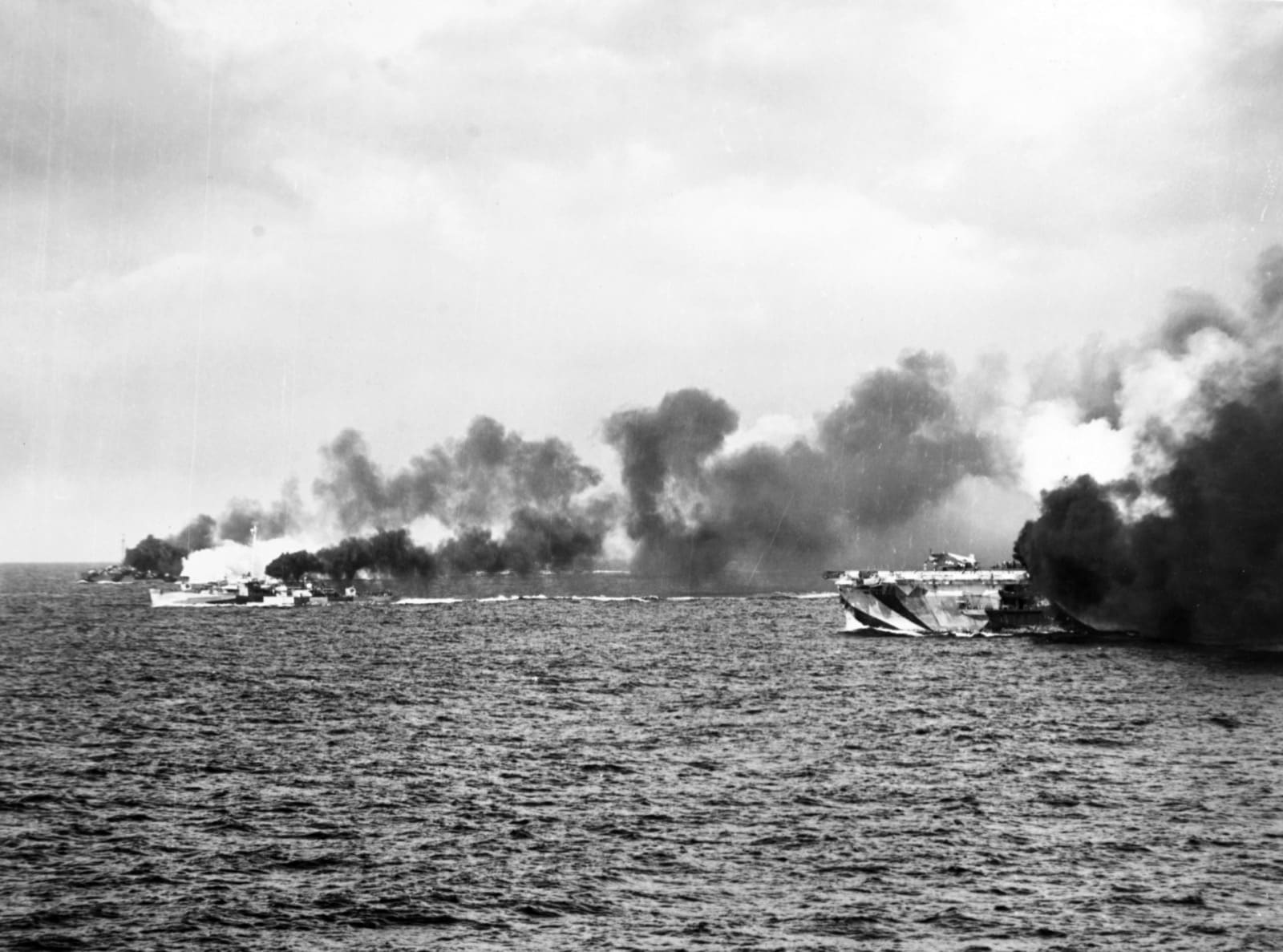
The first ships Kurita met on the morning of 25 October were Task Unit 77.4.3, radio call sign Taffy 3, under Rear Admiral Clifton A. F. Sprague.
Taffy 3 was built to support troops ashore, not to fight battleships. It had six escort carriers: Fanshaw Bay, St. Lo, White Plains, Kalinin Bay, Kitkun Bay and Gambier Bay. Escorting them were three destroyers, Hoel, Heermann and Johnston, and four destroyer escorts: Dennis, John C. Butler, Raymond and Samuel B. Roberts.
At 0641 a scout plane reported an enemy surface force 20 miles off and closing. Sprague’s orders, as recorded by historian Wilfred P. Deac in American Heritage, were plain: “Come to course 090 degrees … launch all planes as soon as possible … speed 16.”
Sixteen knots was close to all an escort carrier had. Sprague turned into the wind to launch, then ran, laid smoke, and hid in a rain squall.
The small boys go in
Commander Ernest E. Evans had told his crew at Johnston’s commissioning: “This is going to be a fighting ship. I intend to go in harm’s way.” He did not wait for an order. He took Johnston straight at the Japanese line, making smoke, and fired ten torpedoes at the heavy cruiser Kumano. At 0727 one hit and blew off her bow.
At 0730 Yamato fired her main battery at Johnston. Hits wrecked the destroyer’s engines and steering. Deac records that Evans came out of one salvo “with half of his clothes blown off and minus two fingers of his left hand.” He kept fighting the ship from the stern, passing steering orders by voice.
Hoel and Heermann followed. Samuel B. Roberts, a destroyer escort never meant for this, went in with them under Lieutenant Commander Robert W. Copeland. Escort carrier planes, many armed with whatever was on hand, kept making runs on the Japanese cruisers.
The cost was heavy. Gambier Bay was hit on the flight deck at 0810, slowed to 11 knots, lost all headway by 0845 and capsized shortly after 0900. She was sunk by gunfire, which very few aircraft carriers ever have been. Hoel and Samuel B. Roberts went down. At 0945 Evans ordered Johnston abandoned. She rolled over and sank at 1010.
Of Johnston’s 327 men, 141 survived, after roughly 50 hours in the water. Evans was seen leaving the ship and never seen again. He received the Medal of Honor posthumously.
On the other side, three Japanese heavy cruisers were lost: Chōkai, Chikuma and Suzuya.
Kurita turns north
A little after 0900, Kurita ordered his ships to come north. The sources do not agree on the minute. Deac puts the order at 0911; other accounts give 0920 or later. They agree on what happened next. The Japanese broke off.
On a signal bridge in Taffy 3, a sailor shouted, “Goddamit, boys, they’re getting away!”
Why Kurita turned is still argued about. His force had been under air attack for two days. The smoke, the rain and the torpedo runs made it hard to see what he was fighting, and he appears to have believed he faced fleet carriers and heavier ships than he did. The invasion beaches at Leyte were never attacked.
It was not over for Taffy 3. That morning St. Lo was hit by a Zero in one of the first organized kamikaze attacks of the war. Deac writes that she “sank in less than twenty minutes.” Off Samar the US Navy lost two escort carriers, two destroyers and a destroyer escort, and 1,161 men killed or missing.
”The world wonders”
Far to the north, Halsey was hearing Kinkaid’s calls for help. At Pearl Harbor, Admiral Chester Nimitz wanted to know the same thing Kinkaid did. His assistant chief of staff, Captain Bernard Austin, drafted a short question.
Navy messages were padded with nonsense at both ends to make code-breaking harder. An ensign added “Turkey trots to water” at the front and “The world wonders” at the end. Decoders were supposed to strip both.
On Halsey’s flagship New Jersey, the radio staff removed the first phrase. The last one read like part of the text, so it stayed. Halsey was handed: “Where is, repeat, where is Task Force Thirty Four? The world wonders.”
He took it as a public insult from his own boss. In his memoir he wrote, “I was stunned as if I had been struck in the face.” His chief of staff, Rear Admiral Robert Carney, told him to pull himself together.
About an hour later Halsey turned the battleships south. They arrived far too late to catch Kurita. Up north, the carrier aircraft he left behind sank all four of Ozawa’s carriers off Cape Engaño, including the fleet carrier Zuikaku. It was a win against a force that had been sent there to lose.
So who was responsible? Halsey went for the bait. Kinkaid assumed a task force existed because of one verb tense and did not ask until it was too late. A sentence written as a plan was read as an order, and a nonsense phrase was read as a sentence. Two years earlier at Midway, the US Navy had won by reading Japanese messages correctly. At Leyte it nearly lost a beachhead by misreading its own.
Johnston is still out there. In March 2021 Victor Vescovo’s submersible Limiting Factor surveyed her wreck off Samar at 6,460 meters, then the deepest shipwreck ever found. In June 2022 the same team found Samuel B. Roberts, deeper still.