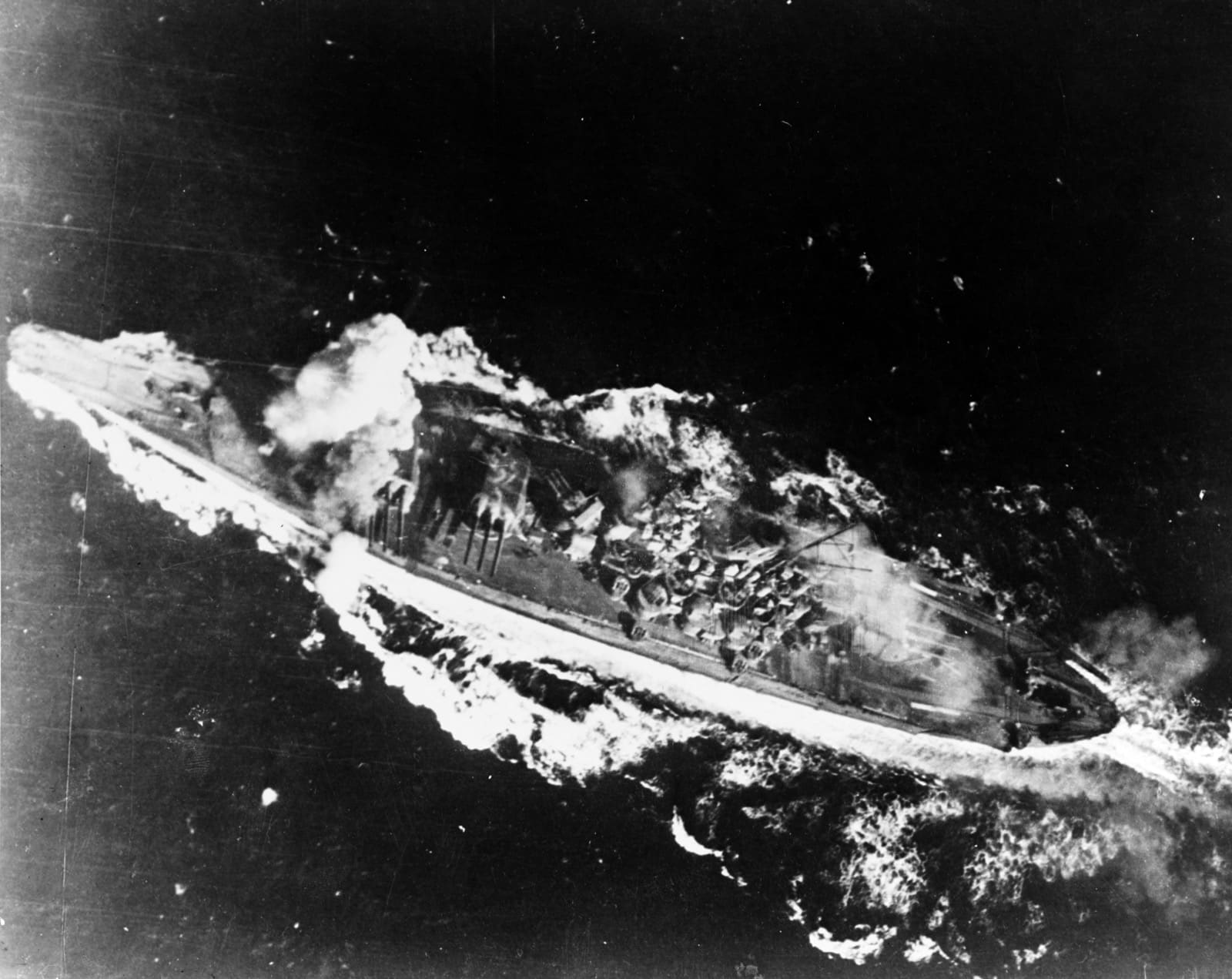
Yamato displaced 71,659 tonnes at full load. She carried nine 46 cm guns, 18.1 inches across the bore, in three triple turrets. No warship before or since has mounted bigger.
She also carried twelve 15.5 cm guns as secondary armament, more than many cruisers mounted as their main battery, and could make 27 knots. Standard displacement alone was 65,027 tonnes.
Her own navy refused to say so. Inside the Imperial Japanese Navy the guns were the “special type 40 cm.” Forty centimeters is 15.7 inches, the size every other navy’s new battleships were using. The name was a cover story built into the paperwork.
A dry dock with a roof on it
Kure Naval Arsenal laid her down on 4 November 1937. The dock was covered with a canopy so nobody on the surrounding hills could judge her size. She was launched on 8 August 1940 and commissioned on 16 December 1941, nine days after Pearl Harbor.
The deception reached Japan’s allies too. In July 1943 the German naval attaché, Wenneker, was allowed aboard. According to the Combined Fleet tabular record of movement, officers debated beforehand whether a German professional could tell a 40 cm gun from a 46 cm one by eye. They handed him a data sheet listing the main armament as 40 cm and kept the tour away from the turrets.
It worked on the Americans. In October 1942 the Office of Naval Intelligence assessed the Yamato class at 35,000 tons with nine 16-inch guns. That is roughly half her real weight.
How the US finally found out
Two things broke the secret, and neither came from the ship.
In February 1944, reconnaissance photographs over Truk caught a Yamato-class battleship at anchor. Photo interpreters at Pearl Harbor measured what they could and concluded the guns were 18-inch. A ship carrying nine of those, they reasoned, had to displace at least 60,000 tons.
The doubters held out until June 1944. Interrogators questioned Noda Mitsuharu, a former yeoman to Admiral Isoroku Yamamoto. He told them sailors used to joke about the “special type” label. That was what finally convinced Edwin Layton, the senior intelligence officer who had held to the 16-inch figure, that the guns were 18-inch.
By the time the Americans were sure, the third hull of the class was already gone. Her converted sister Shinano was sunk by a submarine in November 1944, and the US had learned less about her than about Yamato. When the Navy planned for Yamato’s last sortie in April 1945, its staff work used the real figure: 18.1-inch guns.
The guns she almost never used on a ship
For a battleship built around one weapon, Yamato used it against enemy ships on essentially one morning.
Her first main-battery rounds fired in anger, on 19 June 1944 in the Philippine Sea, were anti-aircraft shells. They damaged four Japanese Zero fighters.
The morning that counted was 25 October 1944, off Samar. Yamato opened fire at 05:58 on American escort carriers roughly 32,000 metres away, about 20 miles. Her spotter plane reported hits before smoke screens hid the targets. At 06:54 a torpedo spread from an American destroyer forced her to turn north, away from the fight.
Which American ships her shells actually struck is still argued. Some accounts credit her with hits on USS Gambier Bay. Japanese and American records do not line up neatly, and several Japanese ships were firing at the same carriers. What is not argued: the escort carriers she was shooting at were thin-skinned conversions, and none of them was a battleship.
Fuel for a one-way trip, and then some
By April 1945 the US was on Okinawa. The Navy General Staff put together Operation Ten-Go: Yamato, the light cruiser Yahagi and a destroyer screen would sail to Okinawa, beach themselves, and fight as shore batteries until destroyed. There was no air cover to give them.
The standard story says she was given fuel for a one-way trip. The records say otherwise. The Combined Fleet record has Yamato taking on 3,400 tons of fuel oil at the Tokuyama depot on 6 April. Wikipedia, citing the official histories, says about 60 percent of capacity was issued, on the authority of local commanders, despite orders that called for less. The men who wrote the plan expected no return. The men who pumped the oil hedged.
The force sailed at 15:20 on 6 April under Vice Admiral Seiichi Ito, with Captain Kosaku Aruga in command of Yamato. Even the escort count differs: Wikipedia lists eight destroyers, Combined Fleet lists nine.
The first wave was sighted at 12:32 on 7 April. Estimates of the total run from about 280 attacking aircraft to 386 depending on the source and what is counted.
Pilots put most torpedoes into her port side, so the list could not be corrected. She took at least 11 torpedoes and 6 bombs. At 14:23 she rolled over and her forward magazine exploded.
Ito and Aruga went down with her, and 3,055 of her 3,332 crew died. Destroyers picked up 276 survivors. She never came within gun range of an American battleship.
The 46 cm turret was designed to outrange anything an American battleship could carry. The Americans never offered that fight. They sent aircraft from carriers far beyond the reach of any gun.
Where she is now
Yamato lies in the East China Sea at 30-22 N, 128-04 E, southwest of Kyushu.
In Kure, the city whose dock once had a roof over her, the Kure Maritime Museum goes by her name: the Yamato Museum. Her guns are described there at their real size, 46 cm, a number that no longer has to be hidden. For a different kind of Japanese design secret, read about the Mogami cruisers, whose weight problem fooled British intelligence the other way.