Ships sink all the time. What makes these different is that nobody found them. No wreckage. No oil slick. No bodies. In some cases, no signal. They sailed out of port with full crews and passengers, and then they were gone.
The ocean covers 139 million square miles. Some of these ships are down there somewhere. A few have since been located. Most have not.
USS Cyclops (1918) — 306 missing
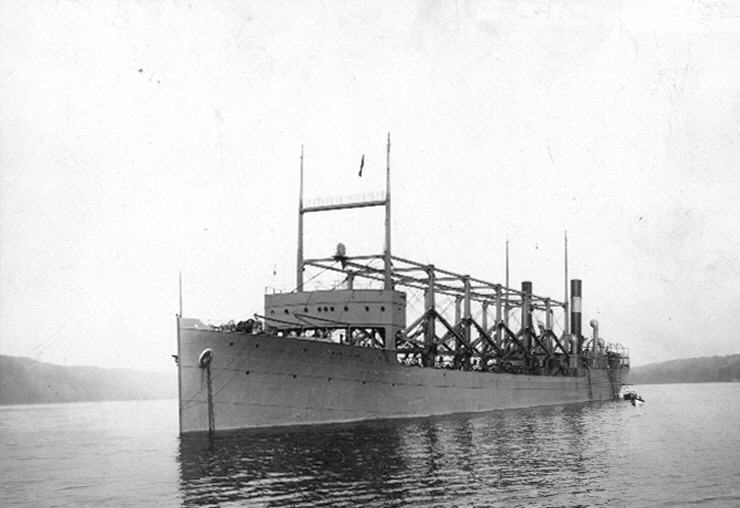
USS Cyclops was a 19,360-ton Navy collier, 542 feet long, built to haul coal and ore for the fleet. On March 4, 1918, she left Barbados carrying 306 people and 11,000 tons of manganese ore bound for Baltimore.
She never arrived. No distress signal was received. No wreckage was found. No bodies washed ashore.
The Navy searched for months. They checked German submarine records after the war. No U-boat had claimed her. They checked for storms. Weather was unreasonable but not catastrophic. They checked the cargo — 11,000 tons was above her recommended limit, and manganese ore shifts unpredictably in a ship’s hold.
One of her two engines had been disabled before the voyage. Her captain, Lieutenant Commander George Worley, was under investigation for suspected pro-German sympathies (he was born in Germany as Georg Wichmann). None of these facts explain a 542-foot ship vanishing without a trace.
It remains the largest non-combat loss of life in US Navy history. The full story of USS Cyclops is one of the most baffling in the Navy’s records.
Two of Cyclops’ sister ships — USS Proteus and USS Nereus — disappeared on the same route in 1941. Also without a trace. Also carrying heavy metallic ore.
SS Waratah (1909) — 211 missing
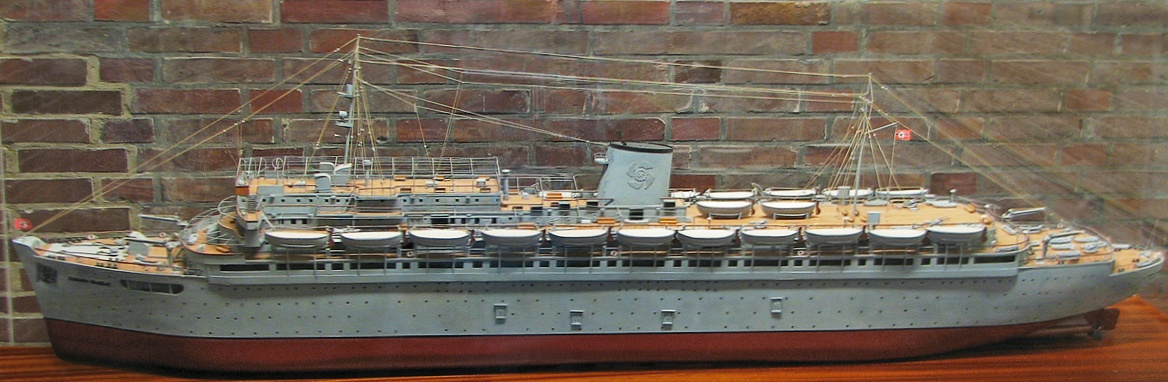
SS Waratah was a passenger and cargo steamer, 465 feet long, built in 1908 for the Blue Anchor Line’s route between Britain and Australia. On July 26, 1909, she left Durban, South Africa, bound for Cape Town with 211 passengers and crew.
One passenger, Claude Sawyer, had disembarked at Durban and refused to reboard. He told anyone who would listen that the ship rolled badly and felt top-heavy. He described a recurring nightmare of a man in armor holding a bloody sword, standing on the ship’s bow.
The Waratah was last seen the following morning by the cargo ship Clan McIntyre. After that, nothing.
The search lasted months. The Royal Navy, the South African government, and the Blue Anchor Line all sent ships. Three chartered search vessels covered thousands of square miles. They found nothing — not a lifeboat, not a deck chair, not a body.
A court of inquiry in 1910 concluded the Waratah had capsized in heavy weather, probably due to insufficient stability. But without wreckage, that was a guess.
In 1999, marine explorer Emlyn Brown claimed to have located a wreck off the Eastern Cape coast using sonar. He spent years investigating. The identification was never conclusively confirmed.
SS Waratah is sometimes called “Australia’s Titanic,” though she disappeared three years before the Titanic sailed.
MV Joyita (1955) — 25 missing
MV Joyita was different. They found the ship. They never found the people.
She was a 69-foot wooden motor vessel, built in 1931 in Los Angeles. By 1955 she was operating in the South Pacific, registered in Western Samoa. On October 3, 1955, she left Apia, Samoa, bound for the Tokelau Islands, 270 miles away. She carried 25 people — crew, government officials, a doctor, a pharmacist, and two children.
She never arrived.
Five weeks later, on November 10, a merchant vessel found the Joyita drifting 600 miles off course near the Fijian island of Vanua Levu. She was listing heavily to port, her decks awash, partially waterlogged. But she hadn’t sunk.
That was the strange part. Joyita’s hull was lined with cork. She was, for practical purposes, unsinkable. The captain — an American named Thomas “Dusty” Miller — knew this. So why did everyone abandon a ship that couldn’t go down?
The investigation found a corroded pipe below the waterline that had been leaking into the engine room. The radio was set to the distress frequency but the antenna wire was broken. The logbook, sextant, and some cargo were missing. A doctor’s bag was found with bloody bandages inside.
The leading theory: the leak flooded the engine room, killing the engines and the pumps. Miller, likely injured in some kind of altercation, tried to keep everyone aboard. Others panicked, launched life rafts, and left. The rafts were never found.
The South Pacific is full of sharks.
USS Scorpion (1968) — 99 dead
USS Scorpion was a Skipjack-class nuclear submarine, 251 feet long, carrying 99 men and two nuclear torpedoes. On May 21, 1968, she sent a routine radio message while returning from patrol in the Mediterranean. She was expected in Norfolk, Virginia, on May 27.
She never arrived.
Scorpion was one of four submarines lost worldwide in 1968 — the others were the Israeli INS Dakar, the French Minerve, and the Soviet K-129. 1968 was the worst single year for submarine losses since World War II.
The Navy’s underwater listening network — SOSUS, a chain of hydrophones on the Atlantic floor — had recorded a series of acoustic events on May 22 at coordinates southwest of the Azores. The sounds were consistent with a hull implosion.
In October 1968, the research ship Mizar found Scorpion’s wreckage on the seabed at 9,800 feet, about 400 miles southwest of the Azores. The hull had collapsed. The crew of 99 — who left behind 64 widows and 99 children — were all dead.
The Navy’s official conclusion: probably a torpedo malfunction. A Mark 37 torpedo’s battery may have overheated, causing a hot-run inside the tube. Commander Francis Slattery may have ordered an emergency turn to disarm it. It didn’t work.
Others believe a Soviet submarine sank her during the Cold War’s most tense period — just weeks after K-129 was lost — and both governments agreed to stay quiet. Declassified documents have not settled the question.
Scorpion still sits on the Atlantic floor with her nuclear reactor and two nuclear warheads. The Navy monitors the site. The reactor has never leaked.
The pattern
There is no pattern. That’s the point.
These ships range from a 542-foot Navy collier to a 69-foot wooden motor vessel. They disappeared in the Atlantic, the Indian Ocean, and the South Pacific. Some were overloaded. Some were not. Some were in storms. Some were in calm seas. Some sent distress calls. Most did not.
The ocean is 139 million square miles of water averaging 12,100 feet deep. Ships are small. The sea floor is mostly unmapped. We have better maps of Mars.
What these ships share is silence. They left port with people who expected to arrive somewhere, and then the sea closed over them and said nothing.
The worst naval disasters in history at least left survivors to tell the story. The ships on this list left no one.
Frequently Asked Questions
What is the most famous ship that disappeared without a trace?
USS Cyclops is the most famous military vessel to disappear without a trace. She vanished in March 1918 with 306 people aboard while sailing from Barbados to Baltimore. No distress signal was sent, no wreckage was ever found, and the disappearance remains the largest non-combat loss of life in US Navy history. Among all ships, the Mary Celeste (1872) is arguably more famous, though she was found adrift rather than completely lost.
How many ships have disappeared in the Bermuda Triangle?
The exact number is disputed and depends on how broadly you define the Bermuda Triangle’s boundaries. USS Cyclops (1918) and her sister ships Proteus and Nereus (1941) are the most prominent military vessels associated with the area. However, statistical analysis by the US Coast Guard and Lloyd’s of London has shown that the number of ships lost in the Bermuda Triangle is not significantly greater than in any other comparable stretch of ocean. Ships disappear everywhere.
Was USS Scorpion sunk by the Russians?
The official US Navy investigation concluded that USS Scorpion was most likely lost due to a torpedo malfunction — specifically, a Mark 37 torpedo battery overheating inside its tube. However, some researchers and former military officials believe a Soviet submarine sank Scorpion in retaliation for or in connection with the loss of Soviet submarine K-129 earlier in 1968. Declassified documents have not definitively resolved the question. The wreck sits at 9,800 feet in the Atlantic with two nuclear warheads still aboard.
What happened to the passengers of MV Joyita?
No one knows. When MV Joyita was found drifting five weeks after her disappearance in 1955, all 25 people aboard were gone. The ship was waterlogged but afloat — her cork-lined hull made her virtually unsinkable. Bloody bandages were found in a doctor’s bag. The life rafts were missing. The leading theory is that the crew and passengers abandoned the ship after flooding disabled the engines, not realizing the ship would stay afloat. The life rafts were never found. None of the 25 people were ever seen again.
Sources
- USS Cyclops — Naval History and Heritage Command
- SS Waratah — Wikipedia
- MV Joyita — Wikipedia
- USS Scorpion (SSN-589) — Wikipedia
- Offley, Ed. Scorpion Down: Sunk by the Soviets, Buried by the Pentagon. Basic Books, 2007.
- The Disappearance of the Waratah — Amusing Planet
- MV Joyita: Ghost Ship of the Pacific — Discovery UK
- What Really Happened to the Nuclear Sub USS Scorpion? — HistoryNet
- List of missing ships — Wikipedia
Photo credit: “Ships lost at sea” composite — Wikimedia Commons, public domain