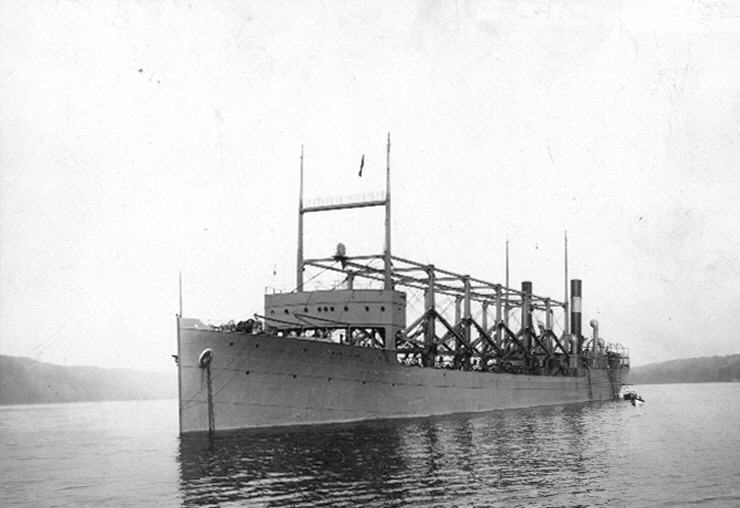
USS Cyclops was a Proteus-class collier, 542 feet long, displacing 19,360 tons fully loaded. She was built to haul coal for the Navy’s fleet. Launched in 1910, she spent the first years of her career doing exactly that — dull, reliable supply runs along the Atlantic coast.
In early 1918, the Navy assigned her to carry manganese ore from Brazil to Baltimore. Manganese was critical for steel production, and steel was critical for the war. She loaded 11,000 tons of it in Bahia, Brazil on February 15.
That was more than her recommended capacity.
The captain
Lieutenant Commander George W. Worley ran the Cyclops. He was born Georg Anton Wichmann in Germany and later became a naturalized American citizen. The crew did not like him. Officers filed complaints about his behavior. He drank heavily and was known for walking the deck in his underwear carrying a cane.
His German birth raised suspicion during wartime, though it proved nothing. What mattered more was that Worley was erratic. Several officers had requested transfers off the ship before this voyage.
The last stop
Cyclops left Bahia and made an unscheduled stop in Barbados on March 3. One of her two engines had broken down. She could not fix it in Barbados, so she sailed on with one working engine.
On March 4, 1918, she left Barbados with 306 people aboard — crew and passengers — headed for Baltimore.
She never arrived.
Nothing
No distress signal. No SOS. No wreckage. No bodies. No oil slick. No debris washing up on any shore.
The Navy searched. They searched extensively. They found nothing.
This was not a small vessel lost in some remote corner of the Pacific. Cyclops was a 542-foot ship carrying 306 people on a well-traveled route in the western Atlantic. She vanished completely.
It remains the largest non-combat loss of life in United States Navy history.
What could have happened
The theories start reasonable and stay there, because none of them can be confirmed.
Structural failure from overloading is the simplest explanation. Cyclops was carrying 11,000 tons of manganese ore, above her recommended capacity. Manganese ore is dense — much denser than coal, which the ship was designed to carry. If the cargo shifted in heavy seas, the ship could have capsized fast enough that no one had time to send a signal.
One engine was dead. A ship running on a single engine in rough weather, overloaded with dense cargo, has very little margin for error.
Some suspected Worley of deliberately delivering the ship to Germany. His German birth and erratic behavior fed that theory. But there’s no evidence he did, and no German records support it.
A U-boat attack was investigated. No German submarine operating in the area at the time ever claimed the kill. Imperial Germany kept thorough records of submarine warfare. None mention the Cyclops.
A storm could have taken her, though no major storms were recorded along her route during that window.
Mutiny was proposed. The ship carried some Navy prisoners among her passengers. But mutiny doesn’t explain the complete absence of wreckage.
The sister ships
It gets worse.
USS Proteus and USS Nereus were Cyclops’ sister ships — same class, same design, same builder. In November and December of 1941, both ships disappeared while carrying metal ore on routes through the same stretch of the western Atlantic.
Proteus left St. Thomas on November 23, 1941. She vanished. Nereus left St. Thomas on December 10, 1941. She vanished too.
Three ships of the same class. All carrying heavy ore. All lost in the same general area. No wreckage from any of them. No distress signals from any of them.
That pattern points more toward a design flaw or a shared structural vulnerability than coincidence. But it’s still a guess. No wreckage from any of the three ships has ever been found, and without wreckage, there is no proof.
Still missing
Modern search technology has not found the Cyclops. Side-scan sonar, deep-sea submersibles, satellite imagery — none of it has turned up the ship or any piece of her.
The western Atlantic between Barbados and the Chesapeake Bay is deep water. The ship went down over a century ago. Whatever is left of her is buried under sediment on a seabed that has been searched but never yielded an answer.
The Navy’s official position has not changed since it was first written:
“The disappearance of this ship has been one of the most baffling mysteries in the annals of the Navy, all attempts to locate her having proved unsuccessful. Many theories have been advanced, but none that satisfactorily accounts for her disappearance.”