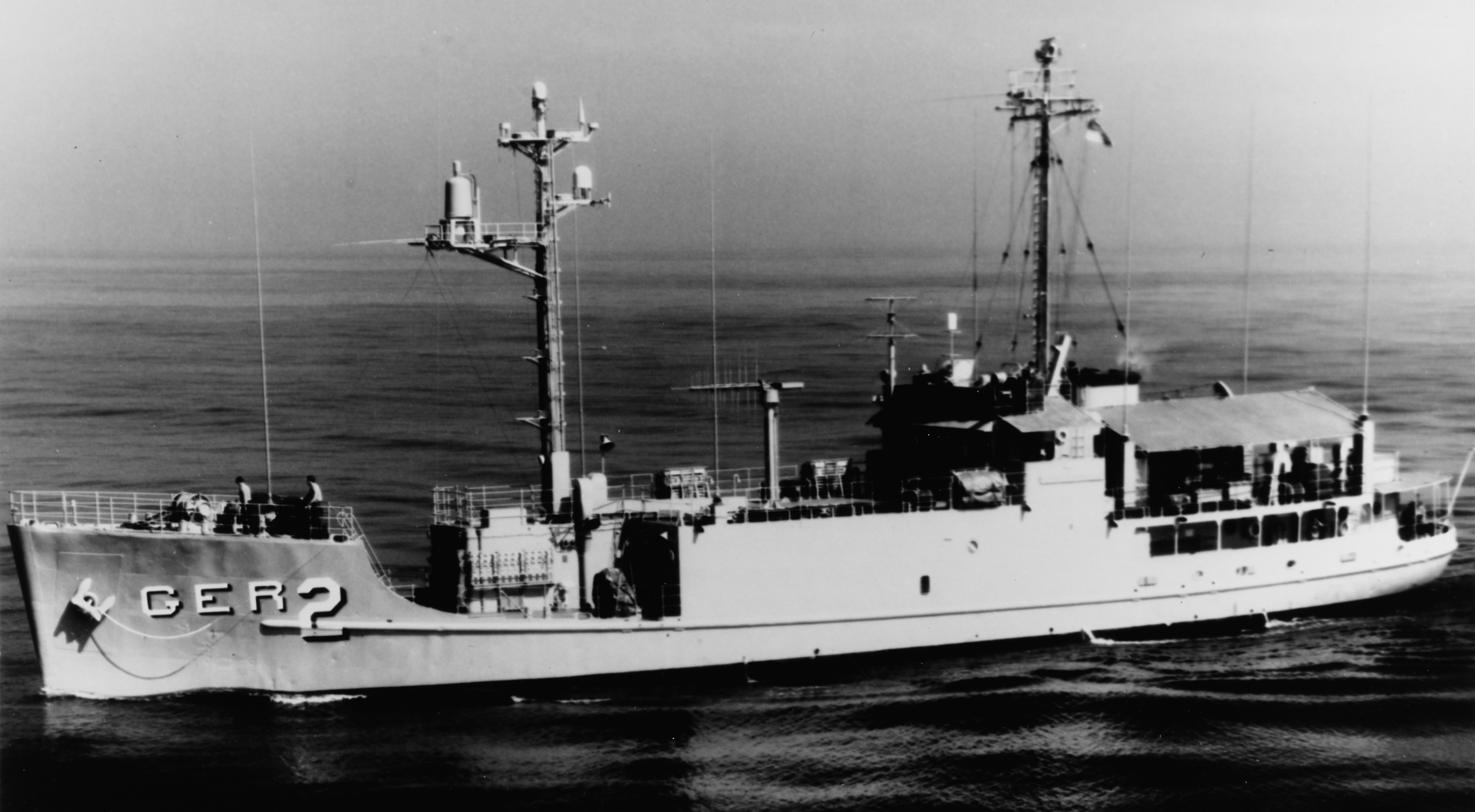
USS Pueblo is still on the US Navy’s commissioned roster. She is also a museum exhibit in Pyongyang, North Korea. Both things have been true since 1968.
The ship
Pueblo started as a US Army freight vessel, FS-344, launched in 1944 at Kewaunee, Wisconsin. The Navy took her in 1966 and spent $1.5 million installing signals intelligence equipment. She was redesignated AGER-2, a Banner-class “environmental research ship,” which was the Navy’s way of saying spy ship.
She displaced 895 tons. Her top speed was 12.7 knots. Her armament consisted of two .50-caliber machine guns mounted in exposed positions on the bow and stern. The guns were covered with canvas tarps. The tarps were frozen solid.
Her crew was 83 men: 6 officers, 75 enlisted, and 2 civilian oceanographers. Her mission was to collect electronic and radio signals off the coast of North Korea.
Commander Lloyd “Pete” Bucher ran the ship. He was 40, born in Pocatello, Idaho, orphaned young, raised at Father Flanagan’s Boys Town in Nebraska. He’d wanted a submarine command, but as a conventional submariner in the Rickover era, he got Pueblo instead.
January 23, 1968
Pueblo was operating 15.8 nautical miles off Wonsan, on the east coast of North Korea. International waters by any standard. The 12-mile territorial limit was 4 miles away.
At around noon, two North Korean submarine chasers armed with 57mm cannon approached. Four torpedo boats followed. Two MiG-21s buzzed overhead.
The lead subchaser signaled Pueblo to heave to. Bucher refused and made for open water at 12 knots. The submarine chasers could do 28.
The North Koreans opened fire. Shells and machine gun rounds hit the ship. Ten crew were wounded. Fireman Duane D. Hodges, from Creswell, Oregon, was struck by shell fragments and killed. He was 20.
Bucher ordered the crew to destroy classified materials. They had two paper shredders. One broke immediately. The incinerators couldn’t keep up. Documents were still piling up when the boarding party came over the rail.
Why Pueblo didn’t fight
The .50-caliber guns were frozen under tarps and accumulated sea spray. Even unfrozen, they required ten minutes to activate. Ammunition was stored in lockers, not staged near the guns. Only ten crew members had ever fired them, and those ten had fired five rounds each.
Bucher had placed the guns as far from the bridge as possible. Anyone manning them would be standing in the open against 57mm cannon at close range.
Two machine guns against six warships and two jets. There wasn’t a decision to make.
Eleven months
The 82 surviving crew were taken to Pyongyang. They were blindfolded, bound, beaten with rifle butts, and denied medical treatment.
The North Koreans wanted propaganda. Confessions, photographs, press conferences showing cooperative American prisoners. The crew gave them photographs.
In staged propaganda photos, crew members extended their middle fingers. When guards asked, they explained it was a “Hawaiian good luck sign.” The North Koreans accepted this and published the photos internationally.
The ruse lasted months. Then Time magazine ran one of the photos with a caption noting the crew was “furtively getting off the US hand signal of obscene derisiveness and contempt.”
The guards read the article. What followed was a period of beatings the crew called Hell Week.
The confession
Commander Bucher held out through 36 hours of continuous interrogation. The North Koreans then brought in the youngest crew member, put a gun to his head, and told Bucher they would execute his men one by one.
Bucher broke and agreed to write a confession. He embedded what resistance he could. He wrote that “We paean the DPRK. We paean their great leader Kim Il Sung.” The word “paean” means a song of praise. It sounds like “pee on.” The North Koreans missed it.
The release
The negotiations at Panmunjom lasted the full 11 months. North Korea demanded an admission of espionage, an apology, and an assurance it wouldn’t happen again.
The US came up with something called a “pre-repudiated apology.” Immediately before signing the document, General Gilbert Woodward read a statement declaring the US was signing solely to free the crew and did not accept anything in the document as true.
North Korea accepted this because they controlled the domestic propaganda narrative.
On December 23, 1968, the 82 crew members walked one by one across the Bridge of No Return at Panmunjom. Duane Hodges’ body was brought to mid-bridge in a North Korean ambulance and transferred to a US truck.
The court of inquiry
Five admirals recommended court-martial for Bucher. The charges: permitting his ship to be seized while he still had power to resist, and failing to ensure adequate destruction of classified materials.
Secretary of the Navy John Chafee overruled them. “Mistakes and miscalculations by the Navy” had led to Pueblo’s “lonely confrontation by unanticipatedly bold and hostile forces,” Chafee wrote. The consequences “must in fairness be borne by all, rather than by one or two individuals whom circumstances had placed closer to the crucial event.”
His closing statement: “They have suffered enough.”
Bucher was not court-martialed. He retired as a Commander. He died on January 28, 2004.
Still there
USS Pueblo sits on the Pothonggang Canal in Pyongyang. She is a centerpiece of the Victorious Fatherland Liberation War Museum. North Korean visitors and foreign tourists walk her decks.
She remains officially commissioned in the United States Navy. She is the second-oldest commissioned vessel after USS Constitution. She is the only US Navy ship held by a foreign power.
Nobody has proposed a plan to get her back.
Sources
- USS Pueblo (AGER-2) — Wikipedia
- H-014-1 The Seizure of USS Pueblo — Naval History and Heritage Command
- Lloyd M. Bucher — Wikipedia
- How Cold War Captives Resisted With the Middle Finger — Atlas Obscura
- The Pueblo Scapegoat — Naval History Magazine