The cruiser Moskva was built in Ukraine.
She was laid down in 1976 at the 61 Kommunara shipyard in Mykolaiv, on the Southern Bug river, then part of the Ukrainian Soviet Socialist Republic. She was launched on July 27, 1979, and commissioned on January 30, 1983, under the name Slava, “Glory.” Forty-six years after her keel went down in Mykolaiv, she went to the bottom of the Black Sea about 80 nautical miles from Odesa, hit by missiles designed in Kyiv.
A Soviet answer to the carrier
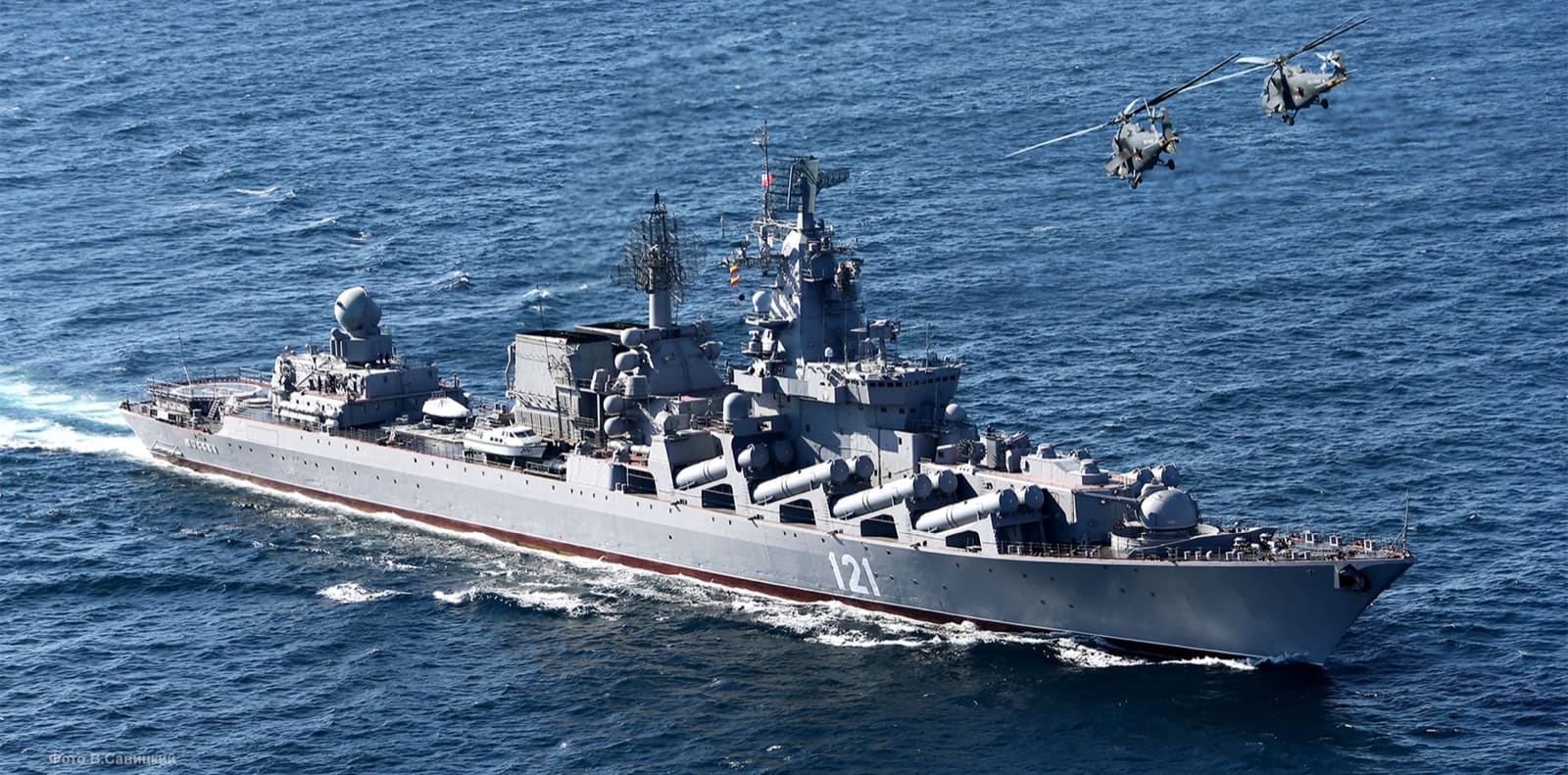
The Slava class was a Soviet design built around one job: killing American aircraft carriers. The most visible proof sits on her deck. Sixteen launch tubes for the P-1000 Vulkan anti-ship missile, NATO name SS-N-12 Sandbox, are mounted in eight pairs along the sides of the superstructure, angled up like a row of organ pipes. Nobody who has seen a photo of the class forgets them.
Behind them, below deck, sat 64 S-300F Fort long-range surface-to-air missiles in eight rotary launchers. Add 40 short-range OSA-M missiles, a twin 130 mm gun, six AK-630 close-in guns, anti-submarine rocket launchers and torpedo tubes. Full load displacement was 11,490 tons on a hull 186.4 meters long. Crew estimates run from 485 to 512.
On paper, that is a ship designed to swat incoming missiles out of the sky.
The Soviet Navy planned four. Slava came first, then Marshal Ustinov and Varyag. The fourth, Admiral Flota Lobov, was laid down in Mykolaiv in 1983 and launched in 1990. Then the Soviet Union ended, and she was still in the yard.
Slava herself spent most of the 1990s idle. She was taken out of service in 1990, renamed Moskva on May 15, 1995, and returned to the fleet in 2000 as flagship of the Black Sea Fleet in Sevastopol. From late September 2015 she provided air defense off Latakia for Russian aircraft operating in Syria.
Snake Island
On February 24, 2022, the first day of Russia’s full-scale invasion, Moskva appeared off Zmiinyi, Snake Island, a small rock in the northwest Black Sea off the Danube delta. Thirteen Ukrainian border guards and servicemen held it.
The Russian ship radioed a demand to surrender. The answer that came back over the radio was “Russian warship, go fuck yourself.”
Contact with the island was lost. Ukrainian officials first reported the garrison killed, and posthumous awards were announced. Days later Ukraine’s navy confirmed the 13 were alive and in Russian captivity.
The phrase spread faster than any official statement from either side. On April 12, 2022 (some sources say April 13), the Ukrainian postal service, Ukrposhta, put it on a stamp: a soldier on the shore, middle finger raised to a gray cruiser. A million were printed. People queued around post offices to buy them.
The next evening, Moskva was hit.
Two Neptunes
On April 13, 2022, around 19:00 local time, Ukraine said it had struck Moskva with two R-360 Neptune anti-ship missiles. The Neptune is a Ukrainian development, a subsonic sea-skimming cruise missile. The strike was launched from the shore. Reported distances vary: Ukrainian sources put the cruiser about 80 nautical miles south of Odesa, and a US defense official told reporters the range was around 60 miles, “well within the Neptune’s effective range.”
Russia’s Ministry of Defense gave a different account. A fire had broken out on board, it said, causing ammunition to detonate. The crew had been evacuated. On April 14 the ministry announced that the damaged ship had lost stability and sunk in stormy seas while under tow to port. It did not mention missiles.
On April 15, US officials told reporters they assessed that two Neptunes had hit the ship. NBC News later reported, citing US officials, that American intelligence had helped Ukraine locate her.
Russia never publicly accepted the missile version. Then, in January 2026, it did, by accident. The Second Western District Military Court in Moscow published a press release stating that “two Ukrainian missiles struck the Moskva,” starting a fire and filling interior compartments with smoke. The release was removed from the court’s website. Mediazona had already saved screenshots.
For scale: no warship this large had been sunk in combat since a British submarine torpedoed ARA General Belgrano, the former USS Phoenix, in 1982. Moskva was also the largest Russian warship lost since the Second World War, and the first Russian fleet flagship sunk in battle since Tsushima in 1905, the war in which the cruiser Aurora was shelled by her own fleet on the way out.
How many died
Nobody outside the Russian government knows for certain, and its own numbers have moved.
The official chronology:
- April 22, 2022. After a week of silence and growing pressure from families, the Russian Ministry of Defense said one sailor was killed, 27 were missing, and 396 crew members were rescued.
- Autumn 2022. A court in Sevastopol declared 17 sailors dead at the request of their commander and parents. Some were conscripts.
- January 2026. The Moscow military court press release counted 20 killed, 24 wounded and 8 missing, losses suffered during a six-hour fight to keep the ship afloat.
Other figures are claims, not counts. Ukrainian officials said only 58 of 510 crew were rescued. Lithuania’s defense minister cited 485 aboard and 54 picked up by a Turkish vessel. The mother of one survivor told the European edition of Novaya Gazeta that “about 40” had died. None of these has been independently confirmed.
What can be said: the Russian government’s first figure was wrong, and the government said so itself, in a document it then deleted.
Her sister is still in the yard
Moskva lies on the floor of the Black Sea. Ukraine has declared the wreck a site of underwater cultural heritage.
Her surviving sisters followed different paths. Marshal Ustinov serves with the Northern Fleet. Varyag is flagship of the Pacific Fleet, a name with its own history on this site: another Varyag, a Soviet carrier, was sold off as a “casino” and became China’s first aircraft carrier.
The fourth ship never left Mykolaiv. Admiral Flota Lobov became Ukraina in the 1990s. Work stopped for lack of money. In 2010 the Ukrainian parliament took the name away. Plans to finish her, sell her or scrap her have come and gone for three decades.
She is still there, unfinished, at the same shipyard on the Southern Bug where Slava was built. The yard that produced the Black Sea Fleet’s flagship now sits in the country that sank it, holding the one ship of the class that never sailed.