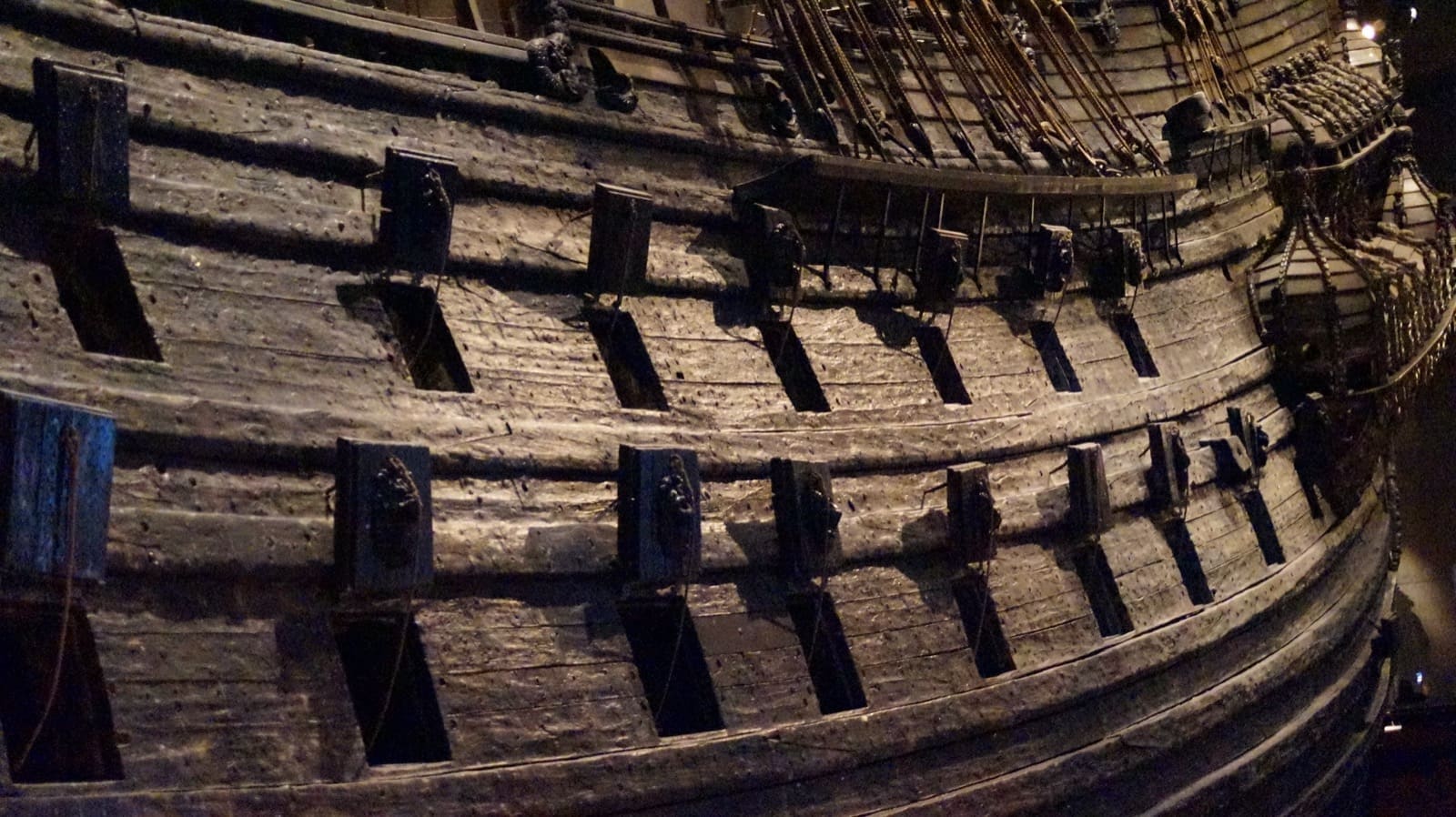
On Sunday, August 10, 1628, the Swedish warship Vasa cast off below the Royal Palace in Stockholm. Crowds lined the shore. Some of the crew had brought their wives and children for the first leg of the trip.
Between four and five in the afternoon, off Tegelviken, a gust of wind pushed her over onto her port side. Water poured through the open gun ports on the lower deck. She went down in 32 meters of water, her masts still sticking out of the harbor.
She had sailed about 1,300 meters. Around 30 people died.
The ship itself is not the strange part. The strange part is that several senior officers knew she would do this, weeks before she did it.
The test they stopped halfway
Vasa was ordered by King Gustavus Adolphus as part of a building program for a navy at war with Poland. She was big for her time: 47.5 meters between perpendiculars, 11.7 meters in the beam, about 1,210 tonnes. Her armament was 64 guns, including 48 bronze 24-pounders spread over two gun decks. A second full gun deck was a lot of weight to carry high on a hull that size.
Some time in the summer of 1628, before she sailed, Captain Söfring Hansson ran a stability test in front of Vice Admiral Klas Fleming. The method was simple. Thirty men ran together from one side of the upper deck to the other and back, and everyone watched how far she rolled.
After three crossings, Fleming stopped the test. He judged that if the men kept going, the ship would capsize right there at the dock.
That is where the story could have ended. A failed test, a delay, more ballast or fewer guns. Instead, nothing happened. According to testimony at the later inquest, Fleming remarked that he wished the king were at home. Gustavus Adolphus was in Prussia, running the war, and his letters to Stockholm kept pushing for the ship to be ready. Nobody in the shipyard had the authority, or the appetite, to tell the king his flagship-to-be was crank.
A ship is “crank” when she is too tender, too quick to heel and too slow to come back. Vasa had too much weight above the waterline and too little hull below it to carry it. There was no formula in 1628 to calculate that. Shipwrights built from experience and proportion, and the math to predict stability would not exist for roughly another century. The test with thirty running men was the best tool they had. It gave the right answer, and they ignored it.
Two rulers on two sides of the hull
When archaeologists studied the raised hull, they found another problem. The ship is asymmetric. There is more structure on the port side than the starboard side.
Four rulers were recovered from the wreck. Two were marked in Swedish feet, divided into 12 inches. Two were marked in Amsterdam feet, divided into 11 inches. A Swedish foot was 29.69 cm. An Amsterdam foot was 28.31 cm. Different teams of carpenters, working from different units, built the two sides of one ship.
The result was a hull that was heavier to port. When the wind hit on August 10, she went over to port.
This was not the sole cause. A perfectly symmetric Vasa would still have been top-heavy. But it is one more thing nobody measured, because nobody had a way to.
The inquest that blamed the dead
The Council sent word to the king immediately. The message took over two weeks to reach him. He replied that the guilty should be punished, and he called it “imprudence and negligence.”
Captain Hansson, who had been dragged under with the ship and survived, was arrested and questioned the same day. He swore the guns had been properly secured and that the crew was sober. Drunkenness was the easy explanation, and he shut it down.
On September 5, 1628, a tribunal of the Privy Council and the Admiralty sat at the Royal Palace. They questioned the surviving officers, the supervising shipwright Hein Jacobsson, and expert witnesses. The prosecutor asked the shipbuilders, more or less: why did you build her so narrow, so badly, and without enough bottom that she capsized?
The builders had a clean answer. They had built to the dimensions the king approved. The king had approved the armament too. The original shipwright, Henrik Hybertsson, had designed her and run the yard, but he had died in the spring of 1627, more than a year before she sailed.
When the tribunal asked the shipbuilder Arendt de Groote why the ship had sunk, he gave the most honest answer in the record: “Only God knows.”
No one was found guilty. No one was punished. The blame, as far as it landed anywhere, landed on Hybertsson, who was in no position to object. Following the evidence any further would have led to the man who approved the drawings and wanted the ship at sea in a hurry. Nobody on that tribunal was going to put the King of Sweden on trial.
Compare her to another first voyage. Japan’s carrier Shinano also went to sea rushed and unfinished, and also lasted less than a day. Different century, same pressure from the top. Closer to her own era, Henry VIII’s Mary Rose capsized in the Solent in 1545 while the king watched from shore. The US Navy’s Cleveland-class cruisers fought the same enemy Vasa did, weight stacked too high, but they had naval architects with the arithmetic to see it coming.
333 years in the mud
Vasa was too expensive to simply leave. In 1663 to 1665, Albreckt von Treileben and Andreas Peckell sent Swedish and Finnish divers down in a diving bell, in cold dark water, to cut loose the bronze guns. They recovered more than 50 of them. Bronze was worth money. Wood was not, and the hull stayed where it was.
Then the ship was forgotten. The Baltic helped. Its brackish water has no shipworm, the mollusk that eats wooden wrecks in saltier seas.
In 1956, an amateur researcher named Anders Franzén went looking with a home-made, gravity-powered coring probe. He found a large wooden object off the dock at Beckholmen, the same island the survivors had swum to in 1628. It was Vasa.
The salvage took five years and more than 1,300 dives, without a serious accident. Divers tunneled under the hull to pass lifting cables through. On the morning of April 24, 1961, Vasa broke the surface for the first time in 333 years. In the mud around her, archaeologists found her anchors, most of the sculptures that had decorated the hull, and the skeletons of at least four people.
Where she is now
Vasa spent 1961 to 1988 in a temporary shed called Wasavarvet. Since 1990, she has stood in the Vasa Museum on Djurgården in Stockholm, a building designed around her. More than 45 million people have walked around her since she came up.
You can stand on the floor of that hall and look up at the upper gun deck where thirty men ran back and forth in the summer of 1628. They stopped after three crossings. Then everybody went back to work.
Sources
- The Disaster (Vasa Museum, Stockholm)
- Vasa (ship) (Wikipedia)
- New Clues Emerge in Centuries-Old Swedish Shipwreck (The World, PRX, 2013)
- Hocker, Fred. Vasa: A Swedish Warship. Medströms Bokförlag, 2011.