Admiral John “Jacky” Fisher said it in 1913: “The most fatal error imaginable would be to put steam engines in submarines.”
The Royal Navy built 18 of them anyway.
The problem
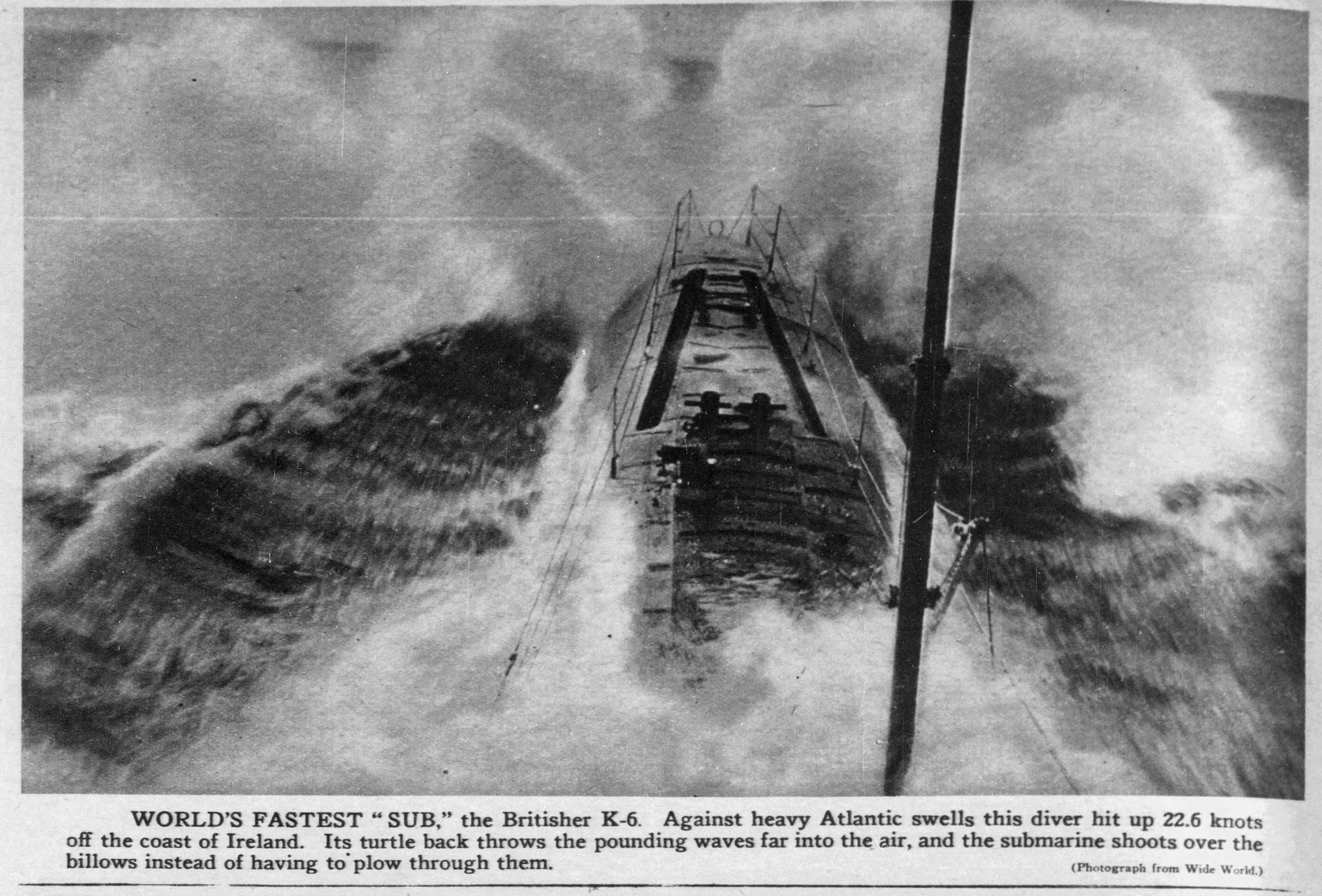
By 1915, Britain had a specific tactical need. The Grand Fleet’s battleships steamed at 21 knots. Battlecruisers made 24. The newest diesel submarines topped out at 19. That meant submarines couldn’t keep up with the fleet, which meant they couldn’t ambush the German High Seas Fleet during a retreat.
The solution was obvious: steam turbines. Twin oil-fired Yarrow boilers, 10,500 shaft horsepower, 24 knots on the surface. Fast enough to run alongside the battle fleet.
The problems started immediately.
The design
The K-class displaced 1,980 tons surfaced, 2,566 submerged. They were 339 feet long. They had two funnels. Funnels on a submarine.
Before diving, the crew had to shut down the boilers, seal the funnels (which retracted into wells in the superstructure), close the boiler room ventilators, and switch to electric motors. A normal transition took 30 minutes. Emergency dives took five minutes at best. K8 once managed 3 minutes 25 seconds. That was considered a triumph.
The boats had a maximum safe depth of 200 feet. At 339 feet long, a steep dive angle meant the bow could be at crush depth while the stern was still on the surface.
The Admiralty ordered 21 of them. Without building a prototype first.
The early accidents
K2 caught fire on her first dive. The crew put it out with buckets of seawater passed hand to hand.
K3 lost control during a test dive and drove her bow into the seabed at 266 feet, well past her 200-foot design limit. The future King George VI was aboard during a separate trial when the same thing happened at 150 feet. She surfaced both times.
K1 collided with K4 off the Danish coast in November 1917. The crew scuttled her to avoid capture.
K13 sank during sea trials on January 29, 1917. Four ventilators were left open when she dived. The engine room flooded. 80 people were aboard: 53 crew, 14 shipyard workers, and various officials. 32 drowned. The survivors spent 57 hours on the bottom of the Gareloch before rescuers cut through the hull.
The Navy raised K13, repaired her, and recommissioned her as K22. Because apparently nobody saw the problem with that.
The Battle of May Island
On the night of January 31, 1918, the Grand Fleet left Rosyth for a fleet exercise. Two submarine flotillas steamed north in the Firth of Forth, ahead of the battlecruisers. The night was dark, the boats were running without lights, and the formations were tight.
K22’s helm jammed. She veered out of line. K14, following behind, couldn’t avoid her. K22 struck K14 and tore off her bow. Two men on K14 died instantly.
The battlecruiser HMS Inflexible, coming up fast behind the submarines, hit the damaged K22 a glancing blow, bending 30 feet of her bow at a right angle.
Then it got worse.
The light cruiser HMS Fearless, leading the second flotilla, rammed K17 at close to full speed. K17 sank in eight minutes. Some of her crew in the water were hit by destroyers following behind.
K6 rammed K4 broadside. K7 then struck the sinking K4. K4 went down with all 55 hands.
The whole thing lasted 75 minutes. 104 men dead. Two submarines sunk, two more crippled, a cruiser missing her bow. No enemy vessel was within a hundred miles.
The court of inquiry sat for five days. The report was classified. Much of it stayed sealed until 1994.
The tally
Of 18 K-class submarines, six sank. None to enemy action.
K5 disappeared in the Bay of Biscay during a mock battle in January 1921. All hands lost. She probably exceeded her safe diving depth.
K15 sank at her mooring in Portsmouth in June 1921. A thermal expansion cycle in the hydraulic oil opened the diving vents while nobody was watching.
The crews who volunteered for K-boats called themselves the Suicide Club.
All surviving boats were scrapped between 1921 and 1926. The fleet submarine concept was quietly shelved. The idea of putting steam engines in submarines was never revisited.
Still there
A memorial cairn stands at Anstruther harbour, overlooking the Firth of Forth where the Battle of May Island happened. It was erected on January 31, 2002, the 84th anniversary. It lists the names of the 104 men who died that night because British ships ran over British submarines in the dark.
Fisher died in 1920. He didn’t live to see the full tally, but he got the important part right in 1913.
Sources
- British K-class submarine — Wikipedia
- Battle of May Island — Wikipedia
- HMS K13 — Wikipedia
- 1915–1926: K Class — Royal Navy Submarines
- South, Andy. The Suicide Club: A History of the Royal Navy’s Steam Powered ‘K’ Class Submarines. 2020.