Tirpitz was commissioned on 25 February 1941 at the Kriegsmarinewerft in Wilhelmshaven. She was the sister of Bismarck, slightly heavier, with the same eight 38 cm guns and a top speed of about 30 knots.
Three months later Bismarck was gone. She had sunk HMS Hood and then been hunted down in the Atlantic in a single week. Tirpitz never made that kind of sortie. She went north to Norway and mostly stayed there, tucked into fjords behind nets and smoke generators. Her crews called her the “Lonely Queen of the North.”
Winston Churchill called her “the beast.”
A ship that worked by sitting still
Tirpitz’s value to Germany was that she might come out. Any Allied convoy running to Murmansk or Archangel had to plan for a 42,900-ton battleship a few hours’ steaming away. The Home Fleet had to keep heavy ships close enough to meet her, ships that could otherwise have been in the Mediterranean or the Pacific.
The clearest result came in July 1942. Convoy PQ 17 was in the Barents Sea when the Admiralty learned Tirpitz might be at sea. The convoy was ordered to scatter. Its merchant ships, now sailing alone, were picked off by U-boats and aircraft. The RAF Museum’s account puts it plainly: the convoy scattered because Tirpitz was believed to be a few hours away. She never got near it.
Her main battery fired at an enemy only once. On 8 September 1943 she sailed with Scharnhorst and nine destroyers to Spitsbergen and shelled Allied-held weather stations and settlements around Isfjorden. Fifty-two 38 cm shells, against huts and coal-mining buildings. That was the battleship’s offensive record.
Six midget submarines
The Royal Navy’s first serious attempt to reach her in her anchorage was Operation Source. Six X-craft, four-man midget submarines, were towed across the North Sea by full-size boats: X5 by HMS Thrasher, X6 by Truculent, X7 by Stubborn, X8 by Sea Nymph, X9 by Syrtis and X10 by Sceptre.
The arithmetic went badly before anyone saw a fjord. X9 broke her tow and was lost with her passage crew. X8 had to be scuttled. X10 was scuttled after the attack was abandoned. X5 was lost with her operational crew.
Two got through. X6, under Lieutenant Donald Cameron, and X7, under Lieutenant Godfrey Place, slipped into Kåfjord and dropped their charges under Tirpitz on 22 September 1943. Both crews ended up in German hands. X7 sank, and two of her men, Whittam and Whitley, could not get out. Place and Sub-Lieutenant Robert Aitken survived as prisoners.
Cameron and Place were each awarded the Victoria Cross while sitting in a prisoner-of-war camp.
The charges went off under the ship. Tirpitz was not sunk. She was badly damaged, and repairs kept her out of action into April 1944. Six submarines lost or scuttled bought about six months.
Planes, then bigger planes
The Fleet Air Arm came next. On 3 April 1944, just as the repairs finished, Operation Tungsten sent Barracuda dive-bombers from British carriers against her in Kåfjord. The Admiralty claimed eight certain hits. None of the bombs got through her main armoured deck. She was out of service again, but she stayed afloat.
The job passed to RAF Bomber Command, and to a weapon designed for something else. The Tallboy was a 12,000 lb deep-penetration bomb built to bury itself in the ground before exploding. Against a ship it could punch through armour that a carrier bomb could not.
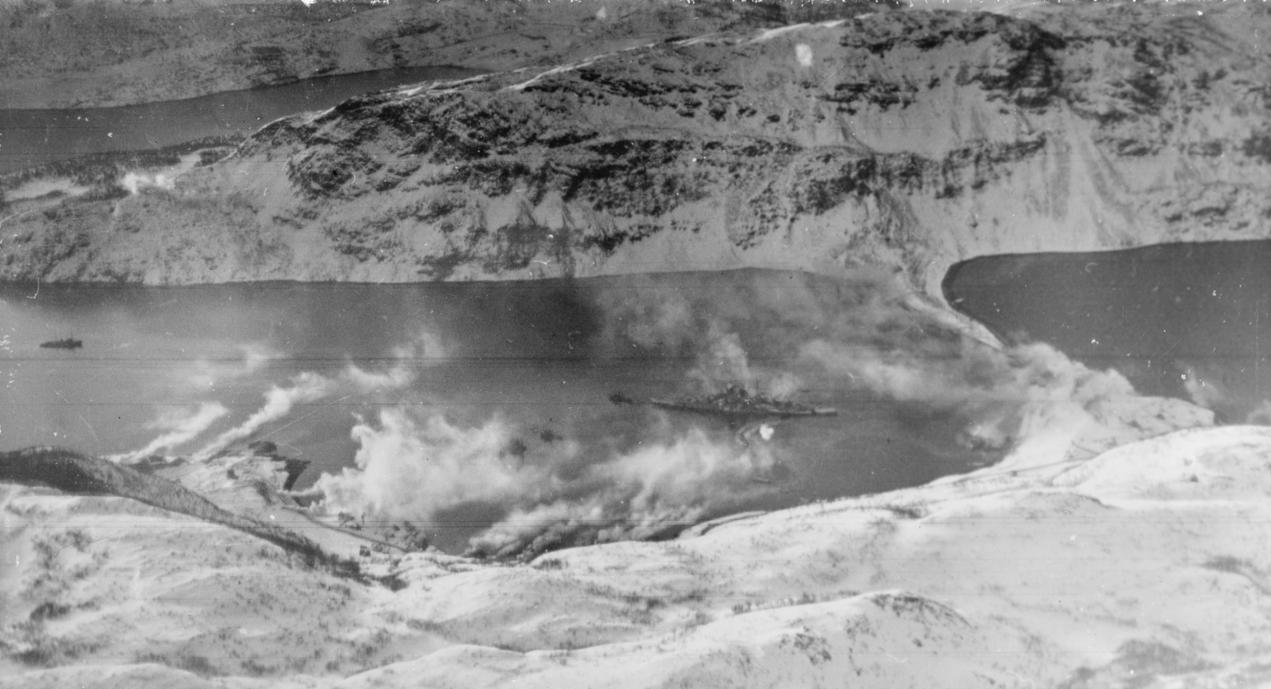
The range was the problem. Kåfjord was too far from Scotland for a round trip. So in September 1944, Operation Paravane flew Lancasters to Yagodnik, a Soviet air station near Archangel, and attacked from there. One Tallboy hit her bow. The Germans judged her no longer fit for sea and moved her south to Tromsø to act as a floating battery against an invasion they expected.
Tromsø was further south. That put her just inside the reach of Lancasters flying direct from Scotland, if they were stripped down and given extra fuel. On 29 October, Operation Obviate tried exactly that. Cloud covered the target at the last moment.
Twelve November
Operation Catechism was the third try with Tallboys. The bombers took off in darkness from Lossiemouth and Milltown in Scotland: 18 Lancasters from 617 Squadron under Wing Commander James Brian “Willy” Tait, 13 from No. 9 Squadron under Wing Commander James Bazin, and a film-unit aircraft from 463 Squadron RAAF. Mid-upper turrets had been removed to save weight. Crews were cut from seven to six. The round trip was more than 2,200 miles and over twelve hours in the air.
The sky over Tromsø was clear. Bombing began at 08:41 GMT. Twenty-nine Tallboys fell in about eight minutes. At least two hit Tirpitz, and a third near miss tore into the seabed beside her.
At 08:51 a magazine exploded and threw one of her main turrets clear of the ship. She rolled over and settled upside down in shallow water off the island of Håkøya, her bottom showing above the surface.
Somewhere between 940 and 1,204 of her crew died. The RAF Museum gives “about a thousand.” Men were trapped inside the inverted hull. Rescuers cut holes through her bottom plating and pulled out 87 of them.
The British lost no one. One No. 9 Squadron Lancaster, hit by flak, landed in neutral Sweden with its crew unhurt.
Tirpitz had fired her main guns at an enemy for one morning in three and a half years. Destroying her had taken six midget submarines, repeated carrier strikes and three heavy-bomber raids. For most of that time she had done exactly what she was built to do in that war: be somewhere the Royal Navy could not ignore.
Compare her sister’s single week in the Atlantic. Tirpitz made a different trade. The fear of her reached as far as France: the 1942 St Nazaire raid rammed a destroyer into the only Atlantic dry dock big enough to take her. She stayed home and made the other side spend.
What is left
After the war the wreck was sold for scrap and broken up where she lay, between 1948 and 1957.
Kåfjord, the anchorage near Alta where she sat for nearly two years and where the X-craft found her, now has the Tirpitz Museum. It holds photographs, documents and personal items recovered from the wreck: letters, uniforms, snapshots of the sailors. Above the fjord, a bomb crater from the carrier raids is still visible.