In October 1904, Russia sent most of its Baltic Fleet to the other side of the world. The plan was to reach the Pacific, join what was left of the Russian ships at Port Arthur, and take command of the sea back from Japan.
The trip was about 18,000 miles. It took seven months. Long before it arrived, the plan had fallen apart.
The fleet kept going anyway.
Seven months at sea
The force was called the Second Pacific Squadron. Its commander was Vice Admiral Zinovy Rozhestvensky. The main body sailed from Libau, on the Baltic coast, on October 15-16, 1904.
The squadron had barely reached the North Sea when it fired on British fishing trawlers off the Dogger Bank, believing they were Japanese torpedo boats. In the confusion it also hit its own cruiser. That story is told in the Aurora’s friendly fire. Britain came close to war with Russia over it. The squadron sailed on.
The squadron rendezvoused off Madagascar and pushed on east. A second, older group of ships under Rear Admiral Nikolai Nebogatov followed to reinforce it.
By May 1905 the combined force had 8 battleships, 3 coastal battleships, 9 cruisers, 9 destroyers and a train of auxiliaries. Its only realistic destination was Vladivostok. The shortest way there ran through the Tsushima Strait, between Korea and Japan.
Admiral Togo Heihachiro was waiting on the other side.
The night lights
At 2:45 a.m. on May 27, the Japanese auxiliary cruiser Shinano Maru spotted the Russian fleet in the dark.
Shinano Maru sent her first wireless report at 4:45 a.m. By 6:05 she had confirmed the Russians were headed into the Tsushima Strait. Togo’s fleet was already at sea from its base in southern Korea.
On paper Togo had fewer battleships: four, against Russia’s eight. He made up for it with numbers everywhere else: 29 cruisers, 21 destroyers and 45 torpedo boats. And his crews had not just spent seven months at sea.
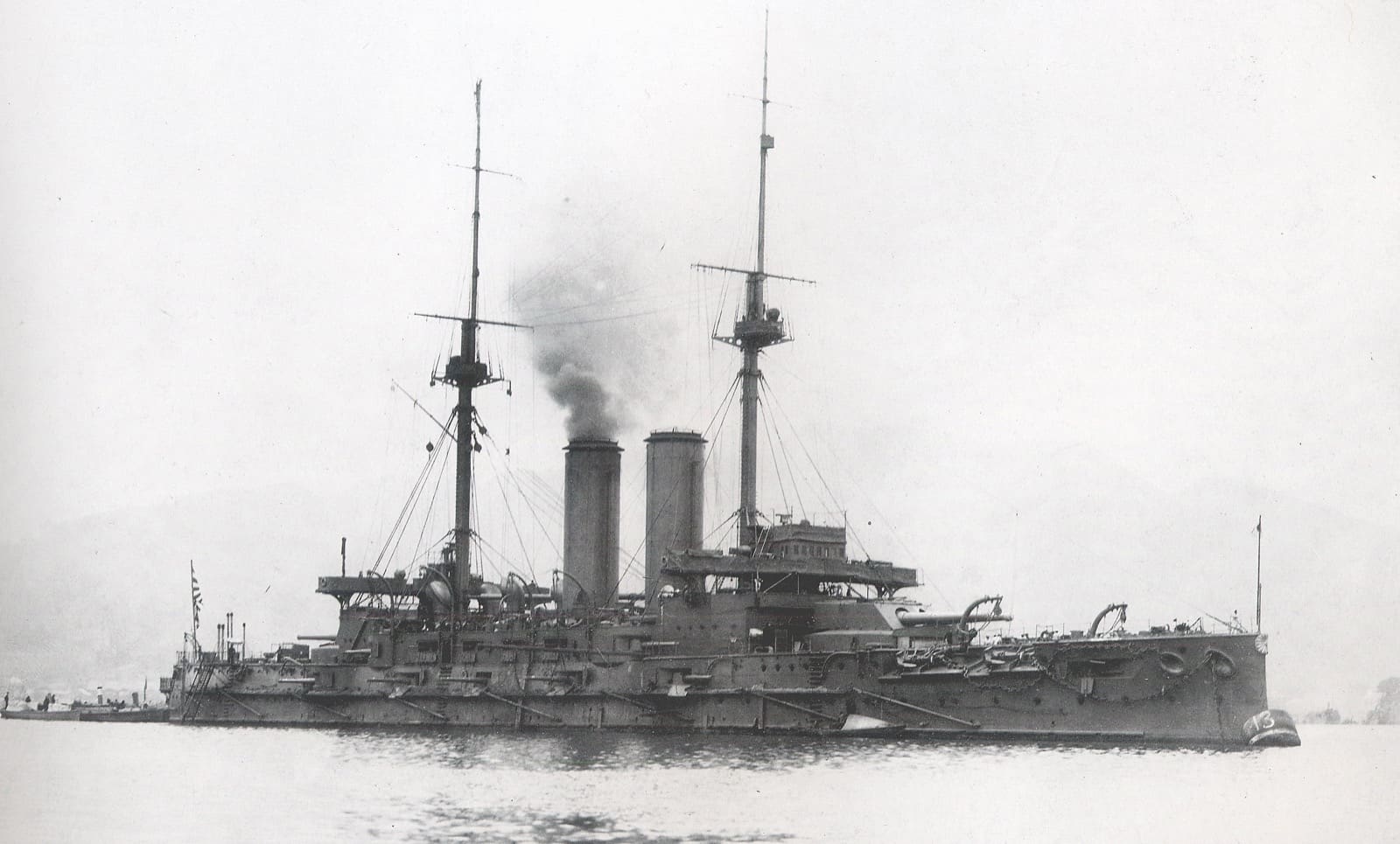
Shortly before 2 p.m. Togo’s flagship Mikasa hoisted the Z flag. By prior arrangement it carried a single message: “The fate of the Empire depends on the outcome of this battle. Let every man do his utmost.” Alongside Nelson’s signal at Trafalgar, the battle that made HMS Victory famous, it is one of the two best-known flag signals in naval history.
Crossing the T
At about 2:05 p.m., Togo turned his battle line hard to port, across the head of the Russian column. The turn put the Japanese ships in front of the Russians and broadside to them. Every Japanese gun could bear. Most of the Russian ships could fire only with their forward turrets, and the ships further back could barely fire at all.
Sources put the moment the T was fully crossed anywhere from 2:05 to 2:45. Either way, the Russian line spent the rest of the afternoon steaming into concentrated fire.
The Russian battleship Oslyabya was the first big ship to go, within the first hour. Rozhestvensky’s flagship Knyaz Suvorov was set on fire and knocked out of the line. Rozhestvensky was wounded by a shell fragment. Imperator Aleksandr III and Borodino sank before dark.
That night the Japanese destroyers and torpedo boats went after what was left. Three Japanese torpedo boats were sunk. Those were the only Japanese ships lost in the entire battle.
The surrender
On the morning of May 28, Nebogatov found himself in charge of the remaining Russian battleships, surrounded by the Japanese main fleet. He hoisted surrender signals. According to some accounts the Japanese kept firing for a while anyway, until the Russian ships stopped their engines. He signed the surrender on board Mikasa at 1:37 p.m.
The destroyer carrying the wounded Rozhestvensky was captured the same day.
The totals were lopsided enough that sources barely bother to argue about them. Russia lost six battleships and a coastal battleship sunk, and two battleships and two coastal battleships captured. The Naval Historical Society of Australia counts 34 of the 38 Russian ships involved as sunk, captured or interned. A handful of cruisers fled to Manila and were interned there. Only the cruiser Almaz and two destroyers reached Vladivostok.
Japan lost 117 dead.
The Russian death toll is where the sources part ways. The figure most often quoted is 5,045 dead and about 6,000 captured. Other accounts give 4,380 dead and 5,917 captured. Either way, more than ten thousand Russian sailors left Tsushima as dead men or prisoners.
Who took the blame
Back in Russia, both admirals were court-martialled. The death penalty was sought for Rozhestvensky, but the Tsar pardoned him: he had been wounded, and the surrender had not been his decision.
Nebogatov had made that decision. He was sentenced to death. The sentence was commuted to ten years in a fortress, and he was pardoned and released in 1909.
It is a strange outcome. Nebogatov surrendered ships that could no longer win and saved the lives of the crews on board. The man who commanded the voyage and fought the battle walked free. Behind both of them stood a government that had sent the fleet halfway around the world in the first place. Nobody court-martialled that decision.
The war ended with the Treaty of Portsmouth later that year. Some of the Russian ships Japan captured or raised went on to serve under the Japanese flag, as the Varyag did.
Mikasa had her own bad luck. Shortly after the peace treaty was signed, she blew up in port. She was raised and repaired. Today she is preserved as a museum ship at Yokosuka, south of Tokyo. You can walk her deck and stand where Togo stood when he hoisted the Z flag.