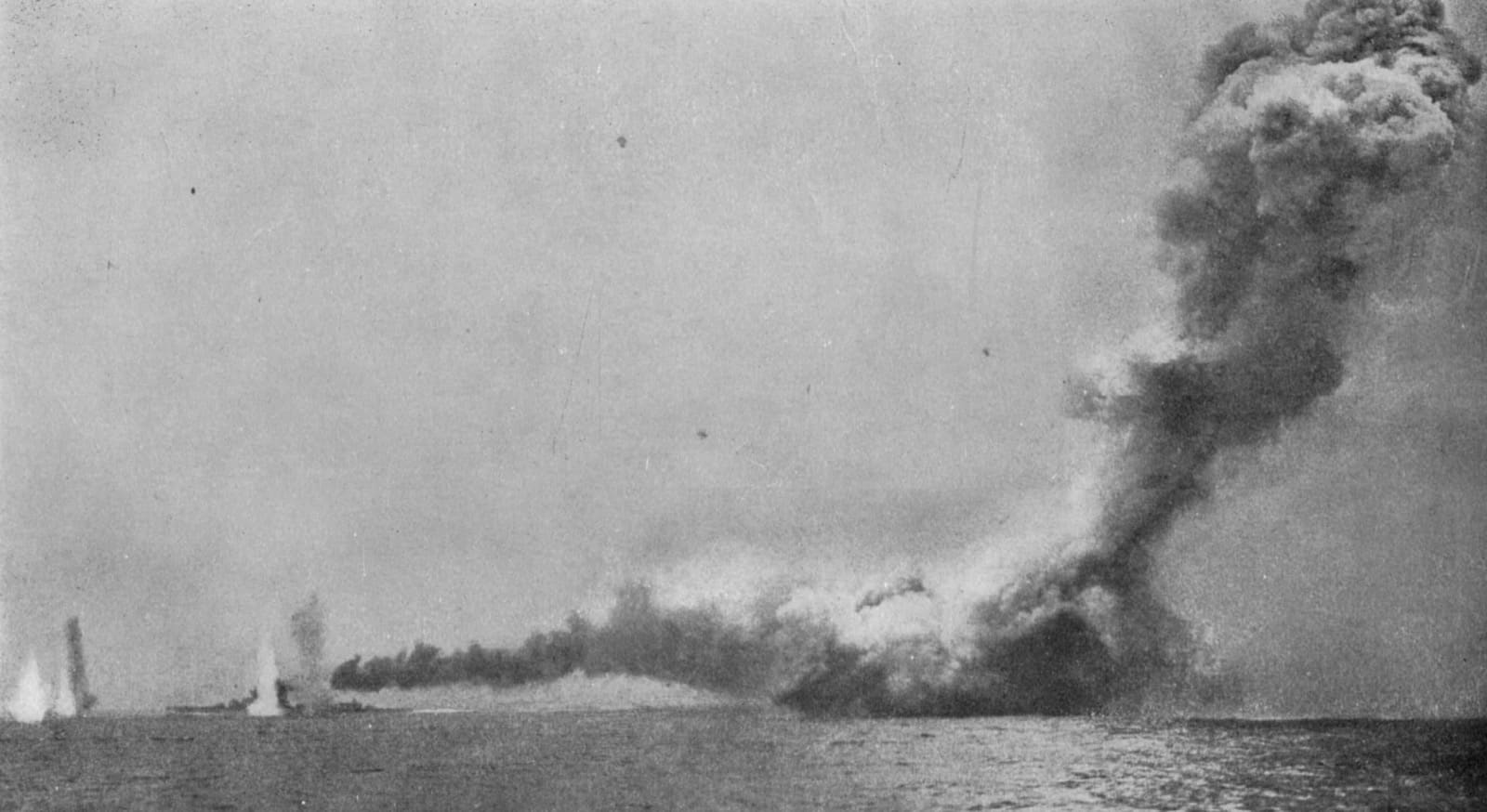
On the afternoon of 31 May 1916, Vice-Admiral Sir David Beatty stood on the bridge of his flagship HMS Lion in the North Sea and watched his battlecruisers disappear.
At 16:02, HMS Indefatigable took three 28 cm shells from SMS Von der Tann and her magazine went up. Of 1,019 men aboard, two survived.
About 23 minutes later, HMS Queen Mary was hit by Derfflinger and Seydlitz. Both forward magazines exploded. Of 1,275 men, nine survived.
Beatty turned to his flag captain, Ernle Chatfield, and said the line every account of the battle quotes: “Chatfield, there seems to be something wrong with our bloody ships today.”
The line gets quoted as a joke about British armor. The more useful question is about the ship Beatty was standing on. Lion had been hit too, on a main turret, minutes before Indefatigable went. Lion did not blow up. Why not?
The hit on Q turret
Just before 16:00, a 30.5 cm shell from Franz Hipper’s flagship SMS Lützow struck Lion’s midships Q turret and burst inside the gunhouse.
Most of the turret crew died. The officer in command, Major Francis Harvey of the Royal Marine Light Infantry, was mortally wounded. He was 43. Before he died, he passed orders down the voice pipe to close the magazine doors and flood the magazine.
Sources disagree on the clock. The standard battle narrative puts the hit at about 16:00. The Jutland centenary site gives 16:30. Lion’s gunner, writing later, remembered 17:00. What they agree on is the sequence: shell, Harvey’s order, flooding.
Then, some time later, cordite charges that had been in the hoist path between turret and magazine caught fire. Gunner Alexander Grant was climbing back toward the magazine to check on it. “Suddenly there was a terrific roar, followed by flame and dense smoke,” he wrote. Over sixty men in the handling spaces and magazine crew died in the flash.
The magazine itself did not go. It was full of seawater.
Harvey received a posthumous Victoria Cross, presented by King George V to his widow, Ethel. Winston Churchill later wrote that in the history of the Royal Marines “there is no name and no deed which in its character and consequences ranks above this.”
The man who emptied the handling room
Harvey’s order is the famous half. The other half belongs to Grant, Lion’s Gunner, a warrant officer responsible for ordnance and magazines.
When Grant joined Lion, his predecessor had just been court-martialled and dismissed the ship. Grant found the magazines in poor shape. Cases of cordite held mixed lots, “five different Lot numbers to each case” in a large percentage of them. The magazine crews, “full of enthusiasm,” had “removed practically every lid from all the cases, piling up the handling room with charges.”
That was the Battle Cruiser Fleet’s habit. Beatty’s squadron prized rate of fire. To feed the guns faster, crews stacked bagged cordite outside the magazines and wedged open the anti-flash doors meant to stop fire travelling down from the turret. British cordite of the period was unstable as it aged, and it sat in silk bags. German charges sat in brass cases.
Grant brought back the old rules, with Captain Chatfield’s backing. In his memoir he listed three:
- Only one magazine in use during action.
- No more than one full charge in the handling room.
- In any lull, the magazine door closed and the watertight clips on.
At Jutland, the eight charges that burned on Lion were the ones in transit. Grant’s own judgment afterward was blunt: if there had been charges lying in the handling room as before, “these would also have exploded.” The Navy Records Society, which published the memoir, credits Grant’s insistence on proper precautions with keeping the flagship from sharing the other ships’ fate.
Invincible, 18:30
The lesson came too late for one more ship. At about 18:30, Rear-Admiral Horace Hood’s flagship HMS Invincible, leading the 3rd Battlecruiser Squadron into the fight, took a shell on Q turret from Lützow or Derfflinger. The magazine detonated. She broke in two and sank in about 90 seconds. Of 1,032 men, six survived. Hood was not among them.
Three battlecruisers, more than 3,300 dead in three explosions. That is over half of Britain’s 6,094 dead for the whole battle.
The Germans had learned this lesson a year earlier. After nearly losing SMS Seydlitz to a cordite fire at Dogger Bank in January 1915, the German navy redesigned its anti-flash doors and restricted how much ammunition could be stacked in the turrets.
Who won
Both sides claimed it.
Germany’s case was arithmetic. Britain lost 3 battlecruisers, 3 armoured cruisers and 8 destroyers, about 113,300 tons, and 6,094 killed. Germany lost 1 battlecruiser, 1 pre-dreadnought, 4 light cruisers and 5 torpedo boats, about 62,300 tons, and 2,551 killed.
Britain’s case was strategic. Admiral Sir John Jellicoe’s Grand Fleet was still at sea and still blockading Germany. Vice-Admiral Reinhard Scheer’s High Seas Fleet went home and never again risked a full fleet action. Germany turned to unrestricted submarine warfare instead. Its surface fleet ended the war at anchor, and in 1919 sank itself at Scapa Flow.
What is not in dispute is that Beatty’s “something wrong” was partly armor and largely procedure. The same squadron that lost three ships to magazine fires had one ship where a warrant officer made his crews close the doors. That ship came home. For more on how wartime Royal Navy shortcuts killed its own men, see the K-class submarine disaster.
Grant’s memoir, “Through the Hawse Pipe,” outlived the ship. The manuscript is held by the Imperial War Museum in London, and the Jutland extract was printed in the Navy Records Society’s Naval Miscellany, Volume VII (2008).